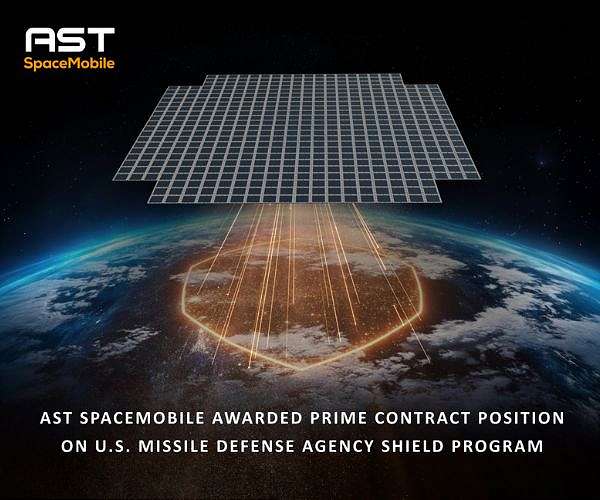
AST SpaceMobile has been selected for a prime contract position on the U.S. Missile Defense Agency Scalable Homeland Innovative Enterprise Layered Defense, or SHIELD, program, placing its space-based cellular broadband architecture inside a key U.S. missile defense modernization effort. The indefinite-delivery, indefinite-quantity framework is designed to rapidly deliver new capabilities across multiple domains for the warfighter, including air, missile, space, cyber, and hybrid threat environments.
The SHIELD program forms part of the U.S. Golden Dome strategy, which aims to build a resilient, layered defensive posture that links sensors, command and control and engagement systems against a broad spectrum of advanced threats. Under the SHIELD multi-award construct, AST SpaceMobile is now eligible to compete for a series of task orders covering research, development, engineering, prototyping and operational support for critical Missile Defense Agency systems that underpin U.S. national security objectives.
Company executives describe the award as a strategic validation of AST SpaceMobile's on-orbit, dual-use satellite technology, which is being developed for both commercial connectivity and defense applications. The firm is building what it describes as the first and only space-based cellular broadband network designed to connect directly with everyday smartphones, while also supporting government users that require resilient communications and sensing solutions in contested environments.
"Being selected as a prime contract awardee for the MDA's SHIELD program is a major validation of our unique, on-orbit, dual-use technology and our growing capabilities within the defense sector," said Chris Ivory, Chief Commercial Officer and Head of Government Business of AST SpaceMobile. "Our innovative low-Earth orbit (LEO) satellite architecture, featuring the largest commercial phased arrays ever deployed in low Earth orbit, is inherently scalable and resilient. This SHIELD IDIQ contract establishes AST SpaceMobile as an eligible provider to bid directly on future task orders, enabling us to rapidly align our cutting-edge space technology with the critical needs of the Department of War and other U.S. Government entities."
The company argues that its approach to a low Earth orbit constellation aligns closely with the Missile Defense Agency's shift toward more distributed and survivable architectures. Those architectures are intended to maintain command and control, battle management and advanced sensing in the face of emerging hypersonic weapons, maneuvering reentry vehicles and complex raid scenarios that could otherwise degrade traditional ground based or single layer defense systems.
AST SpaceMobile's selection underscores the U.S. government's growing interest in leveraging commercial low Earth orbit infrastructure as a core element of integrated deterrence and defense. Within this framework, dual-use constellations can support both civil communications and national security missions, including resilient beyond line of sight connectivity, distributed sensing concepts and data transport for fire control-quality information.
The award also reflects broader U.S. policy that encourages closer collaboration with the commercial space sector to maintain a qualitative edge over potential adversaries. Current administration guidance calls for harnessing private sector innovation to support national security, economic growth and global leadership in space, with the goal of sustaining a decisive advantage in orbit and across connected domains for years to come.
AST SpaceMobile notes that it has structured its manufacturing and operations footprint to support these ambitions with a predominantly domestic industrial base. The company reports that it is about 95 percent vertically integrated, keeping all major manufacturing processes under U.S. control and concentrating its headquarters and primary facilities in Texas.
Altogether, AST SpaceMobile operates nearly 500,000 square feet of manufacturing and operations space and employs close to 1,800 people worldwide, most of them in West Texas. That vertically integrated footprint is supported by a technology platform the firm says is protected by more than 3,800 patents and pending patent claims, spanning spacecraft design, large deployable phased arrays, network architecture and direct-to-device protocols.
The Missile Defense Agency award was made as part of a broader list of companies that have been cleared to compete under the SHIELD program, which the U.S. government publicly announced on January 15, 2026. As SHIELD task orders are released and competed, AST SpaceMobile will seek opportunities to apply its commercial satellite capabilities to government-focused demonstrations and operational deployments.
Company leaders see the SHIELD framework as a vehicle to expand AST SpaceMobile's presence within the defense market while continuing to execute on its primary mission to close mobile connectivity gaps. By operating a single space-based broadband network for commercial and government customers, the firm aims to deliver economies of scale that can support both global smartphone users and specialized defense communities.
Looking ahead, AST SpaceMobile plans to integrate its SHIELD participation with ongoing development of its BlueBird satellite line and SpaceMobile service architecture. The company expects that experience gained through missile defense-related research, prototyping and operations will feed back into the performance, resiliency and security features of its commercial service as it moves toward broader deployment.