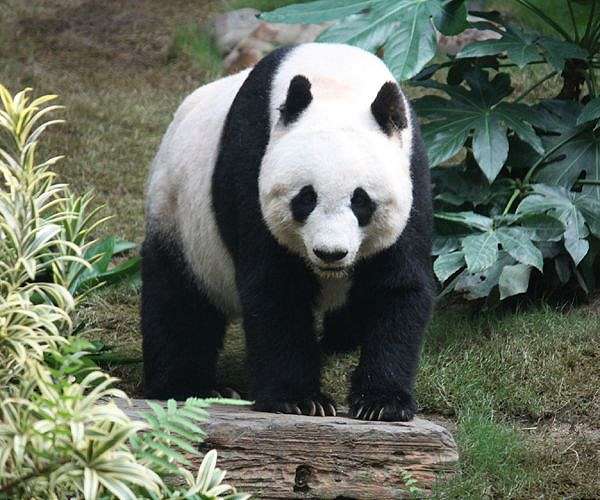
Two pandas at a Tokyo zoo will be returned to China in January, the Tokyo government said on Monday, potentially leaving Japan without the beloved animals for the first time in half a century.
Loaned out as part of China's "panda diplomacy" programme, the distinctive black-and-white animals have symbolised friendship between Beijing and Tokyo since the normalisation of diplomatic ties in 1972.
Japan currently has only two pandas, Lei Lei and Xiao Xiao, at Tokyo's Zoological Gardens in the Ueno neighbourhood.
But the twins are now set to be repatriated a month before their loan period expires in February, said Tokyo Metropolitan Government, which operates the Ueno zoo.
Tokyo's regional government has been asking for the immensely popular mammals to remain at the zoo — where they attract huge crowds — but China didn't agree, according to the Nikkei business daily.
In September last year, animal lovers in Tokyo bid farewell to the parents of Lei Lei and Xiao Xiao who returned home.
Just before they left, thousands of tearful fans came out to catch a final glimpse and take photographs of the beloved bears.
The Asahi Shimbun reported that Tokyo is seeking the loan of a new pair, although their arrival before the return of Lei Lei and Xiao Xiao is seen as unlikely.
Ties between Asia's two largest economies are fast deteriorating after Japan's conservative premier Sanae Takaichi hinted that Tokyo could intervene militarily in the event of any attack on Taiwan.
Her comment provoked the ire of Beijing, which regards the island as its own territory.
Japan's top government spokesman Minoru Kihara said pandas have helped ties with China.
"Exchanges through pandas have contributed to improving the feelings between the people of Japan and China. We hope such exchanges will continue," Kihara told a regular press briefing.
He said that "several local governments and zoos have expressed interest in receiving pandas on loan", but did not state whether the national government was asking China for new animals.
The Ueno zoo has long been the beneficiary of panda diplomacy, having cooperated with facilities in China and the United States to successfully breed giant pandas.
Lei Lei and Xiao Xiao were delivered in 2021 by their mother Shin Shin, who arrived in 2011 and was returned to China last year.
Breeding pandas in a zoo environment is fiendishly tricky due to their difficulties mating, false pregnancies and high mortality rates of newborn cubs.
US, Japan defence chiefs say China harming regional peace
Tokyo (AFP) Dec 12, 2025 –
Beijing's actions are "not conducive to regional peace", Japan's defence minister and US counterpart Pete Hegseth agreed during a call after Chinese aircraft locked radar on Japanese jets near Taiwan, Tokyo said Friday.
The December 6 radar incident came after comments by Prime Minister Sanae Takaichi on Taiwan that infuriated China.
It was followed this week by Chinese-Russian air patrols around Japan.
Hegseth and Shinjiro Koizumi "exchanged candid views on the increasingly severe security situation in the Indo-Pacific region, including the radar incident", the Japanese defence ministry said after the call.
They "expressed serious concern over any actions to increase regional tensions, as China's actions are not conducive to regional peace and stability", the statement added.
Koizumi said on X he told Hegseth that China was "disseminating information that is completely contrary to the facts" about the radar incident.
"However, Japan has made clear that it does not seek escalation and that we are responding calmly while making necessary rebuttals, and we are keeping the door open for dialogue," Koizumi added.
Hegseth's office said they had "discussed… China's military activities" among other issues including "Japan's efforts to increase its defense spending and strengthen its capabilities".
– 'Tactical exercises' –
Takaichi had indicated on November 7 that Japan would intervene with military force in any Chinese attack on Taiwan, which Beijing claims as its own and has not ruled out seizing by force.
Media reports on Friday reinforced suggestions that her comments in a parliamentary debate were unplanned and that she deviated from prepared remarks.
Last week, J-15 jets from China's Liaoning aircraft carrier twice locked radar on Japanese aircraft that had scrambled in international waters near Okinawa, according to Japan.
Fighter jets use their radar for fire control to identify targets as well as for search and rescue operations.
But China's foreign ministry on Wednesday accused Japan of sending the jets "to intrude into the Chinese training area without authorisation, conduct close-range reconnaissance and harassment, create tense situations, and… maliciously hype up the situation".
On Tuesday two Russian Tu-95 nuclear-capable bombers flew from the Sea of Japan to rendezvous with two Chinese H-6 bombers in the East China Sea, then conducted a joint flight around the country, Japan said.
Japan said that it scrambled fighter jets in response.
A day later, Japan and the United States air forces conducted their own joint air drills, Tokyo said.
The "tactical exercises" over the Sea of Japan involved two US B52 bombers, three Japanese F-35 fighter jets and three Japanese F-15s, Tokyo said.
South Korea said Tuesday that Russian and Chinese warplanes also entered its air defence zone, with Seoul also deploying fighter jets that same day.
Beijing confirmed on Tuesday that it had organised drills with Russia's military according to "annual cooperation plans".
Moscow also described it as a routine exercise, saying it lasted eight hours and that some foreign fighter jets followed the Russian and Chinese aircraft.