
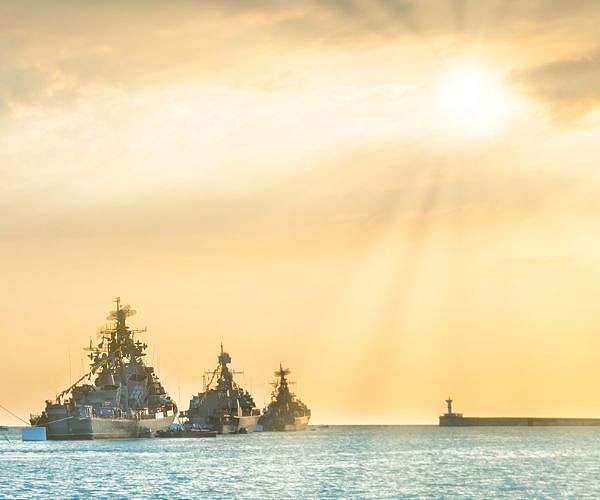
South Africa on Saturday began naval drills with Russia, Iran and China, describing the manoeuvres off its coast as not merely a show of force but a vital response to rising maritime tensions.
The week?long 'Will for Peace 2026' exercises come just days after the United States seized a Russian?flagged oil tanker in the North Atlantic, saying it carried crude bound for Venezuela, Russia and Iran in violation of Western sanctions.
The seizure followed an American raid that toppled Moscow's ally Nicolas Maduro in Caracas.
The drills — led by China — were more than a military exercise and a statement of intent among the BRICS group of emerging nations, Captain Nndwakhulu Thomas Thamaha, South Africa's joint taskforce commander, told the opening Ceremony.
"It is a demonstration of our collective resolve to work together," he said.
BRICS, originally made up of Brazil, Russia, India, China and South Africa, has expanded to include Egypt, Ethiopia, Iran, Saudi Arabia, the United Arab Emirates and, more recently, Indonesia.
China and Iran deployed destroyer warships, while Russia and the United Arab Emirates sent corvette vessels. Host South Africa dispatched a frigate.
Indonesia, Ethiopia and Brazil joined as observers.
"In an increasingly complex maritime environment, cooperation such as this is not an option, it is essential," said Thamaha.
The exercises were to "ensure the safety of shipping lanes and maritime economic activities," he said.
Previously known as Exercise Mosi, the drills were initially scheduled for last November but postponed due to a clash with the G20 summit in Johannesburg, boycotted by the United States.
Washington has accused South Africa and the BRICS bloc of 'anti?American' policies and warned members they could face an additional 10 percent tariff on top of existing duties already applied worldwide.
South Africa has also drawn US criticism for its close ties with Russia and a range of other policies, including its decision to bring a genocide case against Washington ally Israel at the International Court of Justice over the Gaza war.
South Africa drew criticism for hosting naval drills with Russia and China in 2023, coinciding with the first anniversary of Moscow's invasion of Ukraine.
The three nations first conducted joint naval drills in 2019.
Russia joins Chinese, Iran warships for drills off South Africa
Simon'S Town, South Africa (AFP) Jan 9, 2026 –
A Russian warship arrived off South Africa's main naval base Friday to join Chinese and Iranian vessels for military exercises that risk further damaging Pretoria's relations with Washington.
The exercises draw together several nations feuding with the US administration and come at a time of heightened tensions following Washington's raid on Venezuela.
A Chinese destroyer and replenishment ship, as well as an Iranian forward base vessel, sailed into South African waters earlier this week ahead of the week-long manoeuvres due to kick off at the weekend.
AFP journalists near the Simon's Town base saw the Russian-flagged corvette vessel pull into False Bay.
The China-led "Will for Peace 2026" drill involves navies from the 11-nation BRICS group of emerging nations, which US President Donald Trump has labelled "anti-American".
The United Arab Emirates was also expected to send ships, South Africa's Deputy Defence Minister Bantu Holomisa told Newzroom Afrika television late Thursday.
Fellow BRICS nations Indonesia, Ethiopia and Brazil will send observers, he said.
The remaining members of the grouping are India, Egypt and Saudi Arabia.
The exercise will allow the navies "to exchange best practices and improve joint operational capabilities, which contributes to the safety of shipping routes and overall regional maritime stability", South Africa's defence force said.
– Global tensions –
Asked about the timing of the drill, Holomisa said: "This exercise was planned long before these tensions we are witnessing today."
They were initially scheduled for November 2025 but postponed because they clashed with the G20 summit in Johannesburg.
At odds with South Africa over a range of international issues, the United States boycotted the summit.
It also expelled the South African ambassador last year and imposed 30 percent trade tariffs.
Washington this week seized a Russian-flagged oil tanker it said was part of a shadow fleet carrying oil for countries such as Venezuela, Russia and Iran.
It has threatened action against Iran should protesters be killed in mounting demonstrations sparked by anger over the rising cost of living.
The joint drills have "nothing to do with Venezuela whatsoever", a South African defence ministry spokesman told AFP.
"Let us not press panic buttons because the USA has got a problem with countries," Holomisa said. "Those are not our enemies."
"Let's focus on cooperating with the BRICS countries and make sure that our seas, especially the Indian Ocean and Atlantic, they are safe," he said.
– Bad books –
Priyal Singh, senior researcher at the Institute for Security Studies, told AFP that "Washington has clearly been attempting to put Pretoria in its bad book since the beginning of the current Trump administration".
"The optics surrounding the upcoming naval exercise will likely be used by policymakers in Washington as another prime example of why its bilateral relations with South Africa should be reviewed," he said.
A handful of Ukrainians protested as the Russian vessel arrived, criticising South Africa — which claims to be non-aligned in Russia's war on Ukraine — for hosting the Russian navy.
"They destroyed my city, Kherson, they're wiping it out," said Kateryna Fedkina.
"We're just asking South Africa to not cooperate militarily with Russia because Russia is an aggressive state," she said.
Adding to the criticism, South Africa's Democratic Alliance party said it was misleading to claim the drills were part of BRICS cooperation as alliance heavyweights Brazil and India were absent.
The government was "choosing closer military ties with rogue and sanctioned states such as Russia and Iran", it said.
The exercise marks BRICS's increased emphasis on security issues, said Sarang Shidore, director of the Global South Programme at the US-based Quincy Institute.
That the four BRICS states taking part all have "serious diplomatic or security differences with the United States" also sent a "wider geopolitical signal", he said.
