
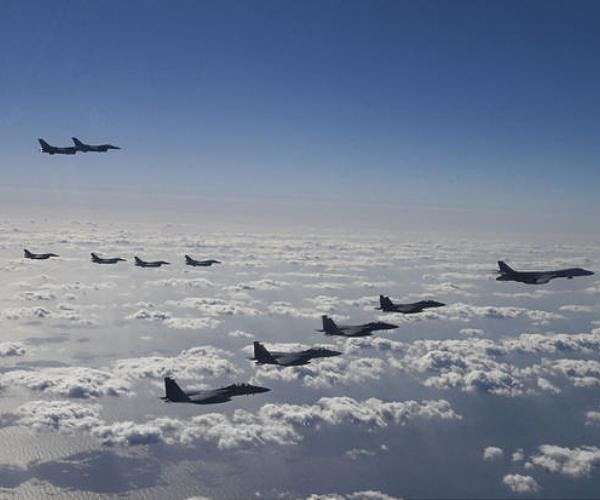
South Korea and Japan reacted furiously on Wednesday after Chinese and Russian military aircraft conducted joint patrols around the two countries, with both Seoul and Tokyo scrambling jets.
South Korea said it had lodged a protest with representatives of China and Russia, while Japan said it had conveyed its "serious concerns" over national security.
According to Tokyo, two Russian Tu-95 nuclear-capable bombers on Tuesday flew from the Sea of Japan to rendezvous with two Chinese H-6 bombers in the East China Sea, then conducted a joint flight around the country.
The incident comes as Japan is locked in a dispute with China over comments Prime Minister Sanae Takaichi made about Taiwan.
The bombers' joint flights were "clearly intended as a show of force against our nation", defence minister Shinjiro Koizumi wrote on X Wednesday.
Top government spokesman Minoru Kihara said that Tokyo had "conveyed to both China and Russia our serious concerns over our national security through diplomatic channels".
Seoul said Tuesday the Russian and Chinese warplanes entered its air defence zone and that a complaint had been lodged with the defence attaches of both countries in the South Korean capital.
"Our military will continue to respond actively to the activities of neighbouring countries' aircraft within the KADIZ in compliance with international law," said Lee Kwang-suk, director general of the International Policy Bureau at Seoul's defence ministry, referring to the Korea Air Defence Identification Zone.
South Korea also said it deployed "fighter jets to take tactical measures in preparation for any contingencies" in response to the Chinese and Russian incursion into the KADIZ.
The planes were spotted before they entered the air defence identification zone, defined as a broader area in which countries police aircraft for security reasons but which does not constitute their airspace.
Japan's defence ministry also scrambled fighter jets to intercept the warplanes.
– 'Routine exercise' –
Beijing later Tuesday confirmed it had organised drills with Russia's military according to "annual cooperation plans".
Moscow also described it as a routine exercise, saying it lasted eight hours and that some foreign fighter jets followed the Russian and Chinese aircraft.
Since 2019 China and Russia have regularly flown military aircraft into South Korea's air defence zone without prior notice, citing joint exercises.
In November last year Seoul scrambled jets as five Chinese and six Russian military planes flew through its air defence zone.
Similar incidents occurred in June and December 2023, and in May and November 2022.
Meanwhile Tokyo said Monday it had scrambled jets in response to repeated takeoff and landing exercises involving fighter jets and military helicopters from China's Liaoning aircraft carrier as it cruised in international waters near Japan.
It also summoned Beijing's ambassador after military aircraft from the Liaoning locked radar onto Japanese jets, the latest incident in the row ignited by Takaichi's comments backing Taiwan.
Takaichi suggested last month that Japan would intervene militarily in any Chinese attack on the self-ruled island, which Beijing claims as its own and has not ruled out seizing by force.
