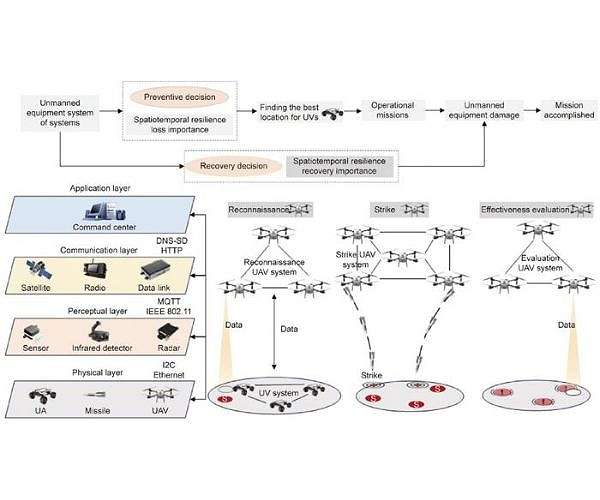
Researchers from Zhengzhou University, the University of Kent, and City University of Hong Kong have developed a framework to evaluate and optimize the spatiotemporal resilience of Internet of Things (IoT)-enabled unmanned system of systems operating in complex missions. The work responds to the growing use of unmanned aerial vehicles and unmanned vehicles in hazardous environments where maintaining function under disruption is critical.
Conventional resilience assessments tend to track performance over time only, but the team argues that spatial factors, such as how platforms are positioned and how far they are from each other, strongly influence communication stability. To address this, the study defines spatiotemporal resilience as a combined measure over both space and time and embeds it in a model tailored to unmanned systems coordinated via IoT.
The authors construct a multi-layered architecture for IoT-enabled unmanned systems of systems that links physical assets and data flows. The structure includes physical, perceptual, communication, and application layers, with unmanned platforms such as UAVs and UVs in the physical layer and data exchange and cross-layer links handled in the data-related layers. This integrated representation is used to map the real-time state of the system during missions.
Within this architecture, the study introduces spatiotemporal performance metrics that capture system behavior as conditions change in both dimensions. Mathematical expressions account for path loss, signal frequency, and distances between UAVs and UVs to quantify how communication quality and system function evolve. These metrics underpin a method for optimizing resilience through maintenance planning and deployment strategies.
In the prevention phase, the authors design an optimal routing algorithm for unmanned vehicles to reduce path loss and strengthen the data layer. For the recovery phase, they propose a repair and reconfiguration scheme that focuses first on UAVs with higher recovery importance, aiming to restore overall resilience more quickly.
A case study tests the framework using a hexagonal layout involving six UAVs and one unmanned vehicle. Under this scenario, the optimization strategy increases prevention spatiotemporal resilience by 0.22 percent, recovery spatiotemporal resilience by 8.39 percent, and overall spatiotemporal resilience by 11.29 percent. These results indicate measurable gains when both spatial deployment and temporal dynamics are considered together.
The authors argue that incorporating spatial and temporal dimensions into resilience analysis can guide the design and operation of future unmanned systems used for tasks such as surveillance, disaster response, and environmental monitoring. They conclude that coupling IoT technologies with spatiotemporal metrics offers a route to more robust and adaptable unmanned fleets in dynamic, uncertain environments.
Research Report:Spatiotemporal Resilience of IoT-enabled Unmanned System of Systems