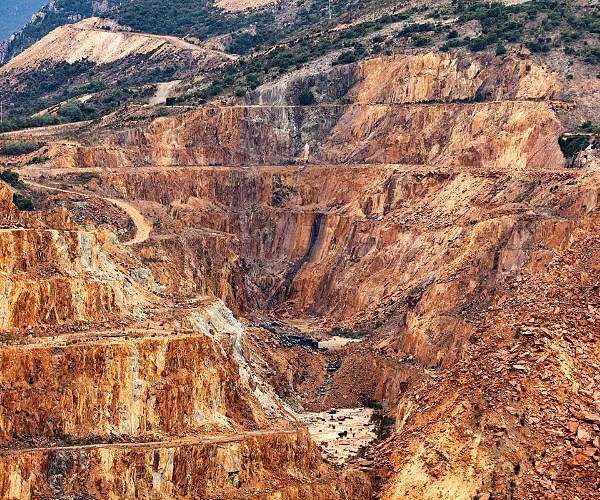
The price of copper must at least double to trigger enough new mine development to meet basic global copper needs over the coming decades, according to a team led by a University of Michigan researcher. The analysis concludes that meeting even conservative demand projections will require both significantly higher copper prices and streamlined permitting to expand mining capacity.
The researchers, led by University of Michigan geologist Adam Simon, examined economic and regulatory barriers to supplying copper under different development and energy transition scenarios. They find that the world can technically obtain the copper it needs, but only if mining becomes more attractive to investors and permitting processes become faster and more predictable.
Under a business as usual pathway driven by normal socioeconomic development in infrastructure, electricity, heating, cooling and other modern technologies, annual copper demand is projected to reach about 37 million tons by 2050. That compares with roughly 23 million tons mined in 2025, highlighting a large supply gap even without an aggressive clean energy transition.
If the global energy system shifts to 100 percent renewable energy and all-electric vehicles, the requirement rises sharply to about 91.7 million tons of copper per year by mid century. In both cases, the team warns that current pricing and regulatory frameworks will make it difficult to increase mining fast enough to meet demand.
Copper currently sells for about 13,000 dollars per ton, but the researchers argue that the price must at least double to give mining companies sufficient incentive to finance and build new projects. To reach this conclusion, they used industry reports, commercial databases and confidential merchant bank data to reconstruct the development costs of existing copper mines in multiple countries.
Their dataset shows that a copper mine in Mongolia cost 18,916 dollars per ton of annual copper production capacity. A Panamanian copper project cost 31,318 dollars per ton of annual copper output, while a United States mine cost 29,614 dollars per ton. Looking ahead, 26 new copper mines expected to begin operations by 2030 are projected to average 22,359 dollars per ton of annual copper capacity.
According to Simon, these figures imply that even today's relatively high prices are not sufficient to support the scale of investment needed. He describes copper as the fundamental linchpin for socioeconomic development, serving as a connective artery for infrastructure, digital systems, and electricity generation, transmission and storage. Without a substantial increase in copper supply, he warns that broad-based global development will stall.
The team also evaluated how much copper could come from sources other than conventional high grade mines. They estimate that recycling could supply about 13.4 million tons per year by 2050, which would cover roughly one third of business as usual demand. Additional copper could be produced by mining low grade rocks and by leaching copper from mine waste, potentially adding about 4 million tons per year.
Substitution with other materials such as stainless steel, aluminum and plastics could ease pressure on copper markets in some applications. However, the researchers note that these alternatives often carry higher greenhouse gas emissions or other tradeoffs, complicating their use in climate driven energy transitions.
Beyond price signals, the perspective stresses the need for permitting reform that accelerates project approvals without weakening environmental and community safeguards. The authors argue that policies to encourage mining should include streamlined and simplified permitting, improved transparency and liquidity in global copper markets, stronger governance and price discovery, and guaranteed offtake agreements that can underpin financing for capital intensive, long term projects.
The paper also highlights the development needs of low income regions that still lack basic copper intensive infrastructure. In the United States, the European Union and other high income economies, the built environment already contains about 441 pounds, or 200 kilograms, of copper per person. By contrast, for each person in India and many African countries, the built environment contains less than 1 pound, or about 0.5 kilogram, of copper.
Bridging this disparity will require vast additional copper for electricity distribution and telecommunications, residential and commercial heating and cooling, plumbing, industrial machinery, rail networks, public transportation and vehicles. The authors argue that these fundamental needs must be considered alongside energy transition goals when assessing future copper demand.
Simon emphasizes that the world is not physically running out of copper resources in the ground. Instead, he says the real constraint is time, because bringing new mines into production quickly enough to satisfy rapidly rising demand requires strong political prioritization and broad public support for mining. Without these, he warns that both economic development and energy transition objectives could be jeopardized.
Research Report:The widening gap between copper supply and demand will have an impact on economic development and energy futures