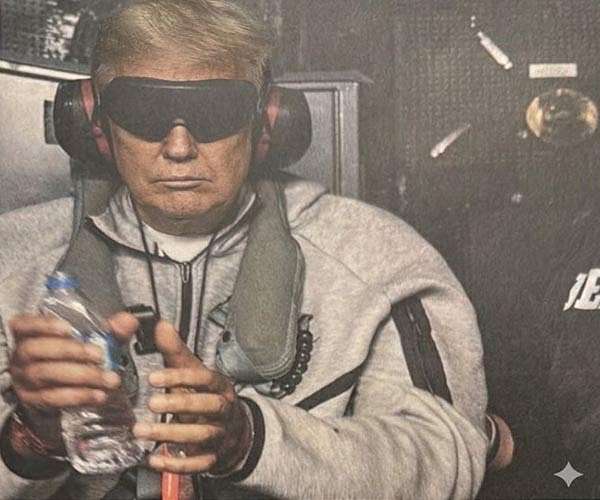
As Donald Trump's decline begins, his fall is unlikely to look like a thunderclap so much as a tide going out. One by one, the people and institutions that once swore they would follow him anywhere are stepping back, hedging, or quietly peeling away. What began as a personality cult is turning into a survival drill for a party, a donor class, and a rising faction around J.D. Vance, all trying to escape an aging, scandal-scarred president before he drags them under in 2026.
On Capitol Hill, senior Republicans are no longer reflexively backing him on foreign policy or key domestic issues. That is a crucial psychological shift in a party that once treated crossing him as career suicide.
Strategists now talk in clinical terms about "down-ballot risk" and "brand toxicity." The question they ask is no longer whether Trump is right or wrong, but whether standing next to him in a campaign ad is more likely to cost them their job than save it.
The Data and the Red Line
Behind that change sits data. Pollsters and campaign professionals see Trump's weak numbers with independents, erosion in college-educated suburbs, and the rise of voters who call themselves "Republican but not MAGA."
When they feed those trends into their models, the outputs keep spitting out the same conclusion: with Trump at the center of the brand, the risk of a midterm bloodbath is uncomfortably high.
For years he survived revelations that would have ended other careers because his flaws were already "priced in." Voters knew the broad outline and chose him anyway.
But there is still a line, and insiders know it. One more tranche of credible, stomach-turning evidence – especially involving minors or clear predation – could snap the last strands holding reluctant allies in place.
That is why the mere specter of Epstein-adjacent material remains politically lethal. The details almost matter less than the perception that worse may be waiting to drop.
The Vance Option
If Trump is the fading center of gravity, J.D. Vance is the obvious beneficiary of any internal collapse.
His rise from venture-capital darling to vice-president was bankrolled by a tight network of tech billionaires who think in terms of risk, return, and optionality. They are already gaming out what happens to regulation, antitrust, crypto, and AI under two more years of a weakened Trump versus under a Vance who owes everything to them.
To the base, Vance plays the loyal co-pilot, fluent in grievance and culture-war language. To donors, he is a systems guy ready to adapt.
If the numbers say that staying glued to Trump means presiding over a historic wipeout, few doubt he would move "in a nanosecond" to present himself as the stabilizing alternative.
Abandonment, meanwhile, proceeds in familiar stages. First come small acts of defiance on votes. Then rhetorical distance from vulnerable incumbents. Then donors and conservative media quietly shift attention to post-Trump figures as everyone notices that everyone else is inching away.
Threaded through this personal drama is a deeper institutional anxiety. Republicans have long relied on the Electoral College and state-level control of elections as structural advantages.
Trump's push for sweeping federal election legislation has unnerved traditionalists who fear it will blur the state-federal line they once defended and invite future Democratic administrations to standardize voting and revisit the Electoral College itself.
In this light, he is no longer just a communications problem but a structural threat. His instincts could permanently weaken Republican leverage in presidential politics, giving institutional conservatives yet another reason to imagine a future without him.
How Vance Pulls the Lever
On paper, Congress and the courts have tools to constrain a rogue president. In practice, the most direct route to benching one runs through the vice-presidency.
Under Section 4 of the 25th Amendment, it is the vice-president who must trigger the process by declaring the president "unable to discharge the powers and duties of his office." He can only do it with a majority of the Cabinet or another congressionally designated body.
Once that declaration is made, he immediately becomes acting president. Even if the president contests it, Congress is arbitrating a conflict in which the vice-president already holds the powers.
That is the quiet leverage in Vance's desk drawer. Outside impeachment, there is no way to remove a sitting president that doesn't start with or pass through the vice-president.
If Congress ever decides both Trump and his understudy are liabilities, it can impeach and convict them together and hand the office down the statutory line of succession, rewarding itself for taking them both out.
In any serious palace-coup scenario, then, Vance cannot afford to be a passenger. If Congress moves first with impeachment aimed at clearing out both offices, he becomes collateral damage.
If he moves first, invoking the 25th with a quorum of Cabinet officers at his back, he becomes acting president and forces Congress to deal with him as the incumbent. That makes it much harder politically for Republicans to remove not just Trump but also the man now holding the office they claim to be saving.
In the world Vance and his tech-world backers are gaming out, the logic is brutal but simple: to survive the fall, he has to lead it.
The future branches from there – on whether early Republican rebels are punished or rewarded, on when Vance's faction judges that a managed succession is safer than sticking with Trump, and on how firmly courts, the military, and the election bureaucracy signal that they will enforce constitutional limits.
History suggests figures like Trump rarely glide into retirement; they are broken by larger forces. He now looks less like the indispensable architect of the Republican future and more like its most dangerous liability – and whether his party can act on that reality will decide not just his fate but the shape of the politics that follow.