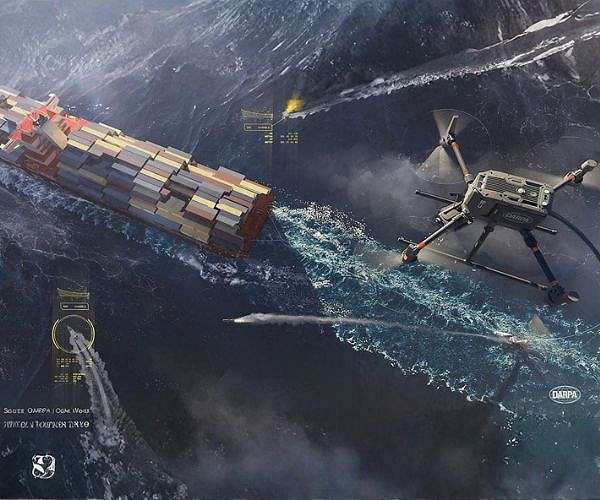
Raytheon, an RTX business, has been selected by the US Defense Advanced Research Projects Agency to develop an advanced sensing and targeting system to protect commercial shipping and naval logistics vessels from emerging maritime threats such as unmanned surface vehicles.
Under the Pulling Guard program, Raytheon s Advanced Technology team will design, build and demonstrate a system that combines Electro-Optical and Infrared sensors, advanced detection software and robust command and control capabilities to improve situational awareness and threat response for vulnerable ships.
The system will mount its sensors on a tethered drone that links to a semi-autonomous unmanned platform towed behind commercial and naval logistics vessels, providing an elevated vantage point for wide-area maritime surveillance and target tracking in congested or contested waters.
Sensor data from the tethered drone will feed real-time target tracking information to remote operators, enabling faster and more informed engagement decisions when hostile unmanned surface vehicles or other threats approach high-value shipping or support vessels.
The program s first phase will emphasize simulated engagements to assess system performance, refine detection algorithms and evaluate operator workflows under realistic threat scenarios and environmental conditions.
In the second phase, the system will be integrated with operational launchers and effectors to support live operations, allowing Raytheon and DARPA to demonstrate end-to-end detection, tracking and engagement of representative maritime threats.
Through this development, we are advancing critical security technologies for commercial shipping in regions like the Red Sea, said Colin Whelan, president of Advanced Technology at Raytheon. By integrating our proven expertise in command and control, high-performance sensing, and effectors, we will deliver a scalable, cost-effective solution that minimizes risks to both cargo and naval assets.
Beyond protection for commercial and logistics vessels, the Pulling Guard technology is expected to support broader naval and security missions, including automated overwatch for medium and large unmanned surface vessels that patrol sea lanes or escort convoys.
Raytheon also sees applications for manned combatants operating in multiple theaters, where elevated, unmanned sensing platforms linked to shipboard command and control systems can extend coverage, fill blind spots and increase reaction time against fast-moving or low-signature threats.
The program aligns with Raytheon s long-standing work in integrated air and missile defense, advanced sensors and networked command and control, drawing on its experience developing layered defense architectures for complex operating environments.
RTX, Raytheon s parent company, positions the effort as part of its broader portfolio of maritime and joint-domain capabilities that are intended to help the United States and its allies protect critical sea lines of communication and maintain freedom of navigation in key regions.
Raytheon and RTX emphasize that the Pulling Guard initiative highlights how emerging technologies in unmanned systems, advanced sensing and automation can be combined to deliver more affordable and flexible defenses for both military and commercial operators at sea.