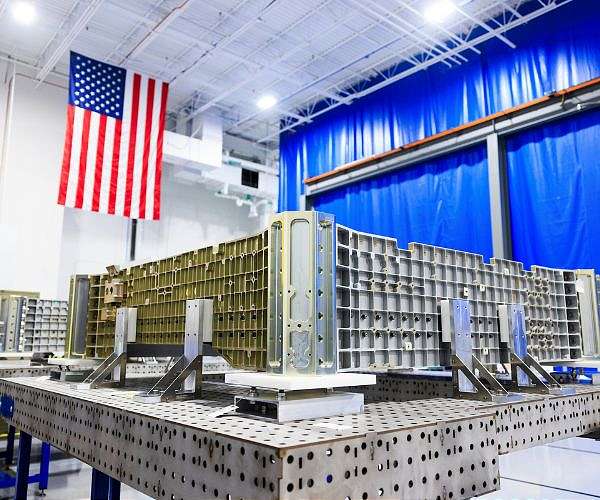
Sierra Space has completed the first nine satellite structures for the Space Development Agency's Tranche 2 Tracking Layer program, delivering Plane 1 of its contracted 18 satellites three months ahead of schedule. The milestone supports delivery and launch preparation timelines for the Tranche 2 Tracking Layer within the Proliferated Warfighter Space Architecture.
Erik Daehler, Senior Vice President of Sierra Space Defense, said the company brought its Victory Works high-rate manufacturing facility online to satisfy SDA production requirements. "We stood up our high-rate manufacturing facility, Victory Works, to meet the demanding requirements of our customer," said Erik Daehler, Senior Vice President of Sierra Space Defense. "To go from a successful Critical Design Review to completing the Plane 1 satellite structures-three months ahead of schedule-is a powerful validation of our investment in scalable infrastructure. Our team is energized as we move into the next phase of Plane 1 development, focusing on assembly, integration, and testing, while also beginning the satellite structure build for Plane 2, the remaining nine satellites of the 18-satellite constellation for SDA."
The next stage for Plane 1 is the assembly, integration, and testing phase, during which components, subsystems, and payloads are integrated and subjected to testing to verify performance and readiness for deployment. This work is intended to confirm that each satellite meets mission requirements before launch.
Daehler emphasized that each phase of development is important to delivering the Tranche 2 Tracking Layer capability. "As we move closer to delivering this capability, every phase of development is essential to ensuring mission success," added Daehler. "We believe the Tranche 2 Tracking Layer will provide unmatched missile tracking capabilities for SDA and its mission partners, and we remain committed to meeting each milestone with precision and speed."
Building on the Plane 1 milestone, Sierra Space is preparing to expand its capabilities to meet future demand for fire-control and missile defense tracking systems. The company plans to scale production capacity and advance detection technologies, including next-generation fire-control missile defense sensors.
"This mission is too important to not be continuously evolving," said John Wagner, Sierra Space Vice President of Strategy and Business Development. "We are scaling our production capabilities and advancing our detection technologies, including the next generation of fire-control missile defense sensors. We believe our infrastructure, expertise, and track record position us to support the Department of War's evolving needs for advanced tracking and missile defense."
Under its SDA contract, Sierra Space will provide two orbital planes totaling 18 satellites, each equipped with infrared sensors to detect and track ballistic, hypersonic, and other next-generation missile threats. These spacecraft contribute to the broader Proliferated Warfighter Space Architecture, which uses distributed constellations in low Earth orbit to provide resilient missile warning and tracking.
According to the Tranche 2 program description, the Tracking Layer will consist of 54 satellites that extend the capabilities of the Tranche 1 Tracking Layer. A subset of Tranche 2 satellites will carry fire-control quality infrared sensors that can generate tracks suitable for initial missile defense mission support for warfighters worldwide.
The Tracking Layer is being designed as a global network of infrared missile warning and missile tracking satellites connected to the Transport Layer's low-latency, meshed communications network. When fully fielded, Tranche 2 is expected to include about 270 operational satellites across the Transport and Tracking layers combined.