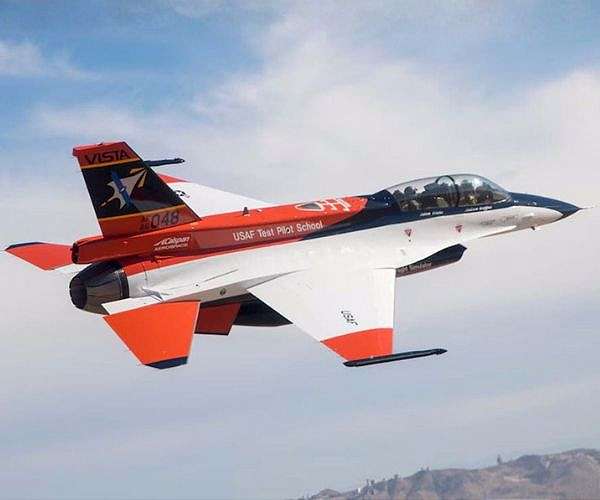
Raytheon has received a U.S. Air Force contract to integrate its PhantomStrike radar on the autonomous X-62A Variable In-flight Simulation Test Aircraft, or VISTA, a modified F-16D Block 30 test aircraft upgraded with Block 40 avionics and configured as a machine-learning and software testbed.
The X-62A VISTA functions as a dedicated platform for flight testing autonomy and artificial intelligence, allowing Air Force and industry engineers to evaluate control laws, sensor fusion approaches and decision-support algorithms in a full-scale fighter environment rather than only in simulators.
The aircraft's hybrid configuration combines legacy F-16 systems with updated avionics and open-architecture software, giving developers access to the flight-control and mission-systems stack so they can insert new code, run experiments and compare autonomous behaviors against safety pilots in real time.
In this role, VISTA supports broader U.S. Air Force efforts such as crewed-uncrewed teaming and collaborative combat aircraft concepts, where autonomous or semi-autonomous platforms fly alongside crewed fighters and bombers to extend sensor coverage, increase weapons capacity and distribute risk.
PhantomStrike is an air-cooled, compact fire-control radar that is smaller, lighter and draws less power than many modern active electronically scanned array radars while being designed for installation on platforms such as uncrewed aerial vehicles, light-attack aircraft and rotary-wing aircraft.
The radar combines digital beam forming and steering with multimode functions and interleaved ground and air targeting so that a host aircraft can search, track and engage airborne targets while also mapping or surveilling terrain and surface objects.
According to Raytheon, PhantomStrike delivers radar capability at nearly half the cost of typical fire-control radars while maintaining targeting and tracking performance needed for both air and surface missions, a cost profile that aligns with the U.S. Air Force goal of fielding larger numbers of autonomous and collaborative aircraft.
As autonomy matures, systems like VISTA give program teams a way to validate how sensors such as PhantomStrike feed data into onboard processors and artificial intelligence algorithms, helping determine how much decision authority can move from human pilots to software for tasks such as threat detection, route planning and weapons employment.
Future autonomous aircraft in this class are expected to rely on compact, efficient sensors that fit within tighter size, weight and power envelopes than legacy fighter radars, enabling designs that are cheaper to procure and operate while still carrying multi-mode surveillance, air-to-air and air-to-surface capabilities.
The combination of an autonomy-focused flight-test platform and a low-power, air-cooled AESA radar is intended to inform how future collaborative combat aircraft and other uncrewed systems will sense the environment, share information with crewed platforms and perform front-line missions such as escort, stand-in electronic support or distributed strike.