
Military Space News
CYBER WARS
Stacked metasurfaces use light and spacing to lock holographic data
illustration only

Stacked metasurfaces use light and spacing to lock holographic data

by Riko Seibo
Tokyo, Japan (SPX) Feb 04, 2026

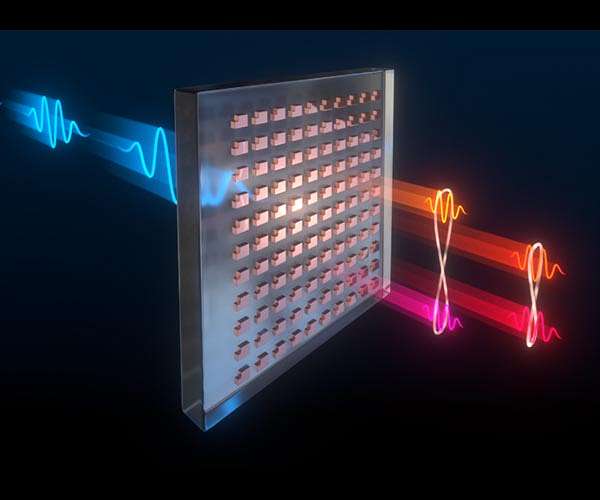
A research team at Pohang University of Science and Technology (POSTECH) has demonstrated a secure holographic platform that encodes and reveals information using only the wavelength of light and the spacing between stacked metasurface layers. The approach targets the growing limitations of conventional digital security by shifting the encryption key from electronic code to the physical properties of light and device geometry.

At the core of the work is a metasurface, an ultrathin optical structure composed of microscopic elements that can precisely control incident light. When illuminated, these engineered surfaces reconstruct holographic images in free space, but traditional configurations have generally stored only a single piece of information per device. To overcome that constraint, the POSTECH team designed a modular diffractive deep neural network in which each metasurface layer plays the role of a neural network layer that processes light as it propagates through the stack.

In this all optical architecture, diffraction and interference act as the computational engine, enabling the system to process and transform information without electronic chips or external power beyond the light source. Each metasurface layer is trained to generate a distinct holographic image at a chosen wavelength, so that one layer can produce an ID pattern while another reconstructs a QR code when illuminated with specific colors of light. As a result, multiple independent data channels can coexist within the same physical platform, with each layer operating as a standalone optical module.

The security capability becomes more powerful when layers are combined at carefully defined separations. When two metasurface layers are aligned with a precise interlayer spacing and illuminated with a designated wavelength, the system reconstructs an encrypted hologram corresponding to a password or other sensitive data. If either the wavelength or the distance between layers is even slightly off target, the encrypted pattern does not appear and the information remains concealed.

In this scheme, the color of the light and the exact spacing between layers jointly serve as a physical password that is not represented in digital form. The researchers note that the number of possible information channels grows rapidly as the design scales, because in theory the number of channels increases as m(2^n-1), where m is the number of available wavelengths and n is the number of metasurface layers. This exponential growth implies that a single stacked metasurface device can host a very large set of independent and combinational holographic outputs.

The team highlights that the same platform supports standalone layer wise functions, multiwavelength operation, and combinational cipher outputs in a single integrated configuration. This flexibility makes the technology attractive for secure identity cards, anti counterfeiting labels on passports and high value products, and protected military or diplomatic documents. It could also underpin new schemes for optical communications in which critical information is encoded in wavelength combinations and layer configurations rather than in conventional electronic signals.

By exploiting the intrinsic properties of light as a security key, the researchers argue that the approach can help address fundamental weaknesses in software based encryption that remains vulnerable as long as it exists as code. "By using the physical properties of light itself as a security key, this study could fundamentally reshape the paradigm of conventional digital security," said Professor Junsuk Rho of POSTECH. "As digital technologies become more advanced, our results highlight that physical security can ultimately provide the strongest solution."

The work was carried out by Professor Junsuk Rho and colleagues at POSTECH across the Department of Mechanical Engineering, Department of Chemical Engineering, Department of Electrical Engineering, and the Graduate School of Convergence Science and Technology. The research appears in the journal Advanced Functional Materials under the title "Recomposable Layered Metasurfaces for Wavelength-Multiplexed Optical Encryption via Modular Diffractive Deep Neural Networks" and received support from the POSCO POSTECH RIST Convergence Research Institute and the National Research Foundation of Korea.

Research Report:Recomposable Layered Metasurfaces for Wavelength-Multiplexed Optical Encryption via Modular Diffractive Deep Neural Networks

Related Links
Pohang University of Science and Technology (POSTECH)
Cyberwar - Internet Security News - Systems and Policy Issues

Subscribe Free To Our Daily Newsletters
Tweet

RELATED CONTENT
The following news reports may link to other Space Media Network websites.
CYBER WARS
'Misrepresent reality': AI-altered shooting image surfaces in US Senate
Washington, United States (AFP) Jan 30, 2026
An AI-enhanced image depicting the moments before immigration agents shot an American nurse ricocheted across the internet - and also made its way onto the hallowed floor of the US Senate. Social media platforms are awash with graphic footage from the moment US agents shot and killed 37-year-old intensive care nurse Alex Pretti in Minneapolis, which sparked nationwide outrage. One frame from the grainy footage was digitally altered using artificial intelligence, AI experts told AFP. The man ... read more

CYBER WARS
AST SpaceMobile secures role on MDA SHIELD defense architecture

Greenland is helpful, but not vital, for US missile defense

Netanyahu says Israel won't let Iran restore ballistic missile programme

Germany puts ballistic missile defence shield into service

CYBER WARS
Raytheon advances next generation short range interceptor with ballistic test

Russian strikes kill 4, wound two dozen in Ukraine

Japan and US agree to expand cooperation on missiles, military drills

Russia claims Oreshnik missile hit Ukrainian aviation plant

CYBER WARS
Drone attacks on Ethiopia's restive Tigray kill one

Poland signs deals for 'Europe's most modern' anti-drone system

Energy learning algorithm boosts complex UAV swarm tasking

India accuses Pakistan of cross-border drone incursions in Kashmir

CYBER WARS
Aalyria spacetime platform tapped for AFRL space data network trials

W5 Technologies LEO payload extends MUOS coverage into polar and remote theaters

Eutelsat orders 340 new OneWeb LEO satellites from Airbus

Europe backs secure satellite communications with multibillion euro package

CYBER WARS
US to launch $12-bn critical minerals stockpile to ease China reliance

Japan, Philippines agree military resupply deal

Cyviz awarded two classified NATO defense contracts for mission critical visualization systems

Japan govt approves record budget, including for defence

CYBER WARS
China's top general probe to 'remove obstacles' in military: state media

India budget pledges record infrastructure and defence boost

US approves approves major arms deals to Israel, Saudi

Starmer says UK should 'do more' with EU in joint defence

CYBER WARS
Dalai Lama's 'gratitude' at first Grammy win

Britain's Starmer ends China trip aimed at reset despite Trump warning

Europe needs to lose 'nostalgia' for US: Germany's Merz

China tells Russia's Shoigu relations could 'break new ground'

CYBER WARS
Engineered substrates sharpen single nanoparticle plasmon spectra

Bright emission from hidden quantum states demonstrated in nanotechnology breakthrough

Subscribe Free To Our Daily Newsletters


The content herein, unless otherwise known to be public domain, are Copyright 1995-2024 - Space Media Network. All websites are published in Australia and are solely subject to Australian law and governed by Fair Use principals for news reporting and research purposes. AFP, UPI and IANS news wire stories are copyright Agence France-Presse, United Press International and Indo-Asia News Service. ESA news reports are copyright European Space Agency. All NASA sourced material is public domain. Additional copyrights may apply in whole or part to other bona fide parties. All articles labeled "by Staff Writers" include reports supplied to Space Media Network by industry news wires, PR agencies, corporate press officers and the like. Such articles are individually curated and edited by Space Media Network staff on the basis of the report's information value to our industry and professional readership. Advertising does not imply endorsement, agreement or approval of any opinions, statements or information provided by Space Media Network on any Web page published or hosted by Space Media Network. General Data Protection Regulation (GDPR) Statement Our advertisers use various cookies and the like to deliver the best ad banner available at one time. All network advertising suppliers have GDPR policies (Legitimate Interest) that conform with EU regulations for data collection. By using our websites you consent to cookie based advertising. If you do not agree with this then you must stop using the websites from May 25, 2018. Privacy Statement. Additional information can be found here at About Us.