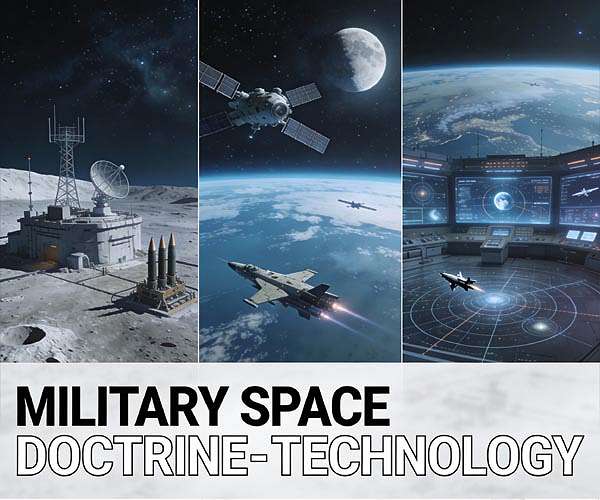
As rivals deploy operational hypersonic vehicles, analysts describe a new Sputnik moment for U.S. tactical space access, with the Pentagon directing more than $6.9 billion toward hypersonic weapons programs for fiscal 2025 and the hypersonic technology market projected at about $8.46 billion this year. The shift away from chasing the lowest launch price toward speed and responsiveness underpins the investment narrative around Starfighters Space Inc (NYSE-A: FJET), AST SpaceMobile Inc, Rocket Lab Corporation, L3Harris Technologies and Kratos Defense and Security Solutions.
Global commercial launch services are reported to be expanding at roughly 14.6 percent annually, with the sector valued at about $8.2 billion in 2024 as satellite operators look for faster deployment and more flexible missions. Prospective U.S. Space Force budget authorizations approaching $40 billion in fiscal 2026 are framed as a driver for reusable platforms, hypersonic propulsion and satellite constellations that can respond to threats in hours instead of months.
Starfighters Space recently issued a year end update following its successful NYSE American listing, describing 2025 as a transformational period for the aerospace firm. Operating from NASAs Kennedy Space Center in Florida alongside large launch providers, the company says it owns and runs the worlds largest commercial supersonic aircraft fleet and is currently the only commercial operator offering sustained Mach 2 mission profiles.
The companys system is built around seven F 104 Starfighter jets that act as reusable first stages, carrying payloads to about 45,000 feet before releasing them toward space, a profile it presents as distinct from conventional rocket stacks. This air launch approach is marketed as providing flexible scheduling, short turnaround times and more tailored orbits for smal sat customers compared with rideshare missions that can involve long delays and limited trajectory choices.
Chief executive Rick Svetkoff said Starfighters public listing marks a key milestone and reflects growing investor interest in firms delivering operational aerospace capabilities aligned with national security, space access and advanced testing demands. He stated that the company is positioned to deliver services across a range of customers through its fast platform, while emphasizing the breadth of missions the aircraft can support.
The companys timing is linked to evolving U.S. policy priorities, including a December 18, 2025 White House executive order on American space superiority that calls for more responsive architectures, accelerated commercial integration and expanded test capacity. Commentators argue that this directive reinforces demand for commercially operated platforms like Starfighters that can support government, defense and space adjacent operations without relying solely on traditional launch providers.
Starfighters reports multiple revenue streams beyond orbital missions, including hypersonic weapons testing carried out with the U.S. Air Force Research Laboratory, a role described as a critical national security function given Russian and Chinese deployment of operational hypersonic systems. Its specialized testing work with AFRL is portrayed as placing the company on the critical path for maintaining U.S. technological parity in hypersonic flight, alongside services such as payload testing, pilot training, microgravity experiments and space hardware qualification.
Customers cited in current programs range across defense and commercial operators, including Lockheed Martin, GE, Innoveering, Space Florida and the Air Force Research Laboratory. The firms STARLAUNCH concept, which leverages AIM 120 missile heritage with more than 17,500 units built, is aimed at smalsat operators caught between paying for costly bespoke launches and accepting uncertain rideshare slots.
At a projected scaled price point of around $15,000 per kilogram, Starfighters is targeting a mid range niche between premium dedicated rockets and lower cost rideshares. Commentators say this pricing, combined with higher launch cadence and schedule control, is intended to create a cost resilient option for institutional customers.
Supporters argue that by offering a high cadence launch and test platform at this price level, Starfighters Space can provide an additional tool for U.S. planners seeking to extract more capability from a Space Force budget that could reach $40 billion amid shifting fiscal priorities. The air launched model is also presented as complementary to ground launched systems fielded by other U.S. and allied providers, broadening the mix of rapid response options for space and hypersonic missions.
AST SpaceMobile is highlighted in the same context after launching BlueBird 6, described as the largest commercial communications array yet deployed in low Earth orbit at nearly 2,400 square feet. The spacecraft, which lifted off from Indias Satish Dhawan Space Centre on December 23, 2025, is designed to deliver peak data rates of up to about 120 megabits per second directly to standard mobile devices to support voice, data and video services for both civilian and government users.
The mission is framed as improving secure connectivity in remote and disaster hit areas, where terrestrial networks may be degraded or absent. AST SpaceMobile plans to place 45 to 60 satellites in orbit by the end of 2026, with launches scheduled every one to two months to build out global coverage for a network backed by more than 50 mobile operator partners representing nearly 3 billion subscribers.
The company lists partnerships with major carriers including ATandT, Verizon, Vodafone, Rakuten, Google, American Tower, Bell and stc Group and reports almost 500,000 square feet of manufacturing facilities worldwide employing more than 1,800 people. In the broader investment narrative, these assets are cast as part of an emerging space based communications layer that could operate alongside military networks in contested environments.
Rocket Lab Corporation closed 2025 with its 21st successful Electron launch of the year, placing the QPS SAR 15 synthetic aperture radar satellite into orbit for Japans Institute for Q shu Pioneers of Space. The December 21 mission from Rocket Lab Launch Complex 1 in New Zealand further expands the iQPS constellation, which supplies near real time radar imagery across a dozen orbits for security and defense end users needing persistent Earth observation.
Company figures note that Electron has now flown 79 missions and is currently the most frequently launched small orbital rocket, a record that supporters say confirms its role as infrastructure for national security payloads. Rocket Lab has carried seven satellites for iQPS so far and is contracted for five more missions beginning in 2026 as the Japanese operator continues to scale its defense oriented imaging network.
L3Harris Technologies recently reported receiving a letter of intent from Kratos Defense and Security Solutions covering a commercial order for 60 Zeus hypersonic motors, described as more than a 50 percent increase in L3Harris annual output of the propulsion line. The Zeus units support U.S. Department of Defense hypersonic and ballistic missile defense test programs such as the Multi Service Advanced Capability Hypersonic Test Bed, following development and flight testing of Zeus 1 and Zeus 2 variants by Kratos.
Executives say the additional production responds to accelerating demand for hypersonic test capacity as the Pentagon, National Science Foundation and U.S. Congress back new systems intended to counter advanced threats from near peer competitors. Ken Bedingfield, president of Aerojet Rocketdyne at L3Harris, stated that by incorporating advanced propulsion technology and providing high performance, the Zeus motors are built to meet current mission requirements while scaling for future test campaigns.
The motors are designed at an L3Harris facility in Huntsville, Alabama to Kratos specifications and produced at the companys energetics campus in Camden, Arkansas, a nearly 2,000 acre site that manufactures more than 115,000 solid rocket motors annually from small units to systems comparable in size to a sport utility vehicle. Commentators note that the expansion aligns with Pentagon reports of $4.7 billion in hypersonic research funding in 2023 and with concerns over Russian and Chinese hypersonic deployments, reinforcing the strategic importance of domestic test infrastructure.
In this framing, Starfighters Space and its peers are presented as core components of a wider responsive space and hypersonic ecosystem built around speed, agility and resilience rather than purely cost per launch. The narrative suggests that platforms capable of rapid test and deployment cycles, including air launched aircraft, small rockets, space based cellular constellations and high rate solid motors, will be central to how the U.S. and allies compete in the emerging arms race in and through space.