
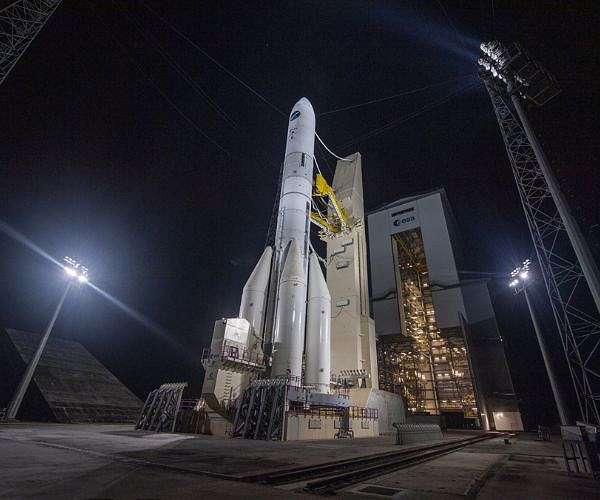
Ariane 6 is set to fly in its maximum four-booster configuration for the second time, carrying 32 Amazon Leo satellites to low Earth orbit on flight VA268. Liftoff is scheduled for 30 April 2026 between 09:08 and 09:57 BST from Europe's Spaceport, with the full flight lasting 114 minutes from liftoff to separation of the final satellites.
The four-booster variant, designated A64, roughly doubles the rocket's lift capacity to low Earth orbit. With four P120C solid-rocket boosters attached rather than the standard two, Ariane 6 can deliver approximately 21.6 tonnes to low Earth orbit, compared with 10.3 tonnes in the two-booster configuration. The P120C is among the most powerful single-piece solid motors in production anywhere in the world.
Flight VA268 also repeats the use of the long fairing first flown on the initial four-booster mission. Standing 20 metres tall, the fairing encloses all 32 Amazon Leo satellites for ascent.
The flight sequence calls for booster separation two minutes after liftoff, followed by fairing jettison at T+3 minutes. The Vulcain 2.1 main engine on the core stage cuts off and the core separates at T+7 minutes. The upper stage Vinci engine then ignites for a first burn from T+8 to T+19 minutes. After a coast phase, Vinci re-ignites at T+1 hour 11 minutes for a second burn lasting approximately one minute. Payload separation begins at T+1 hour 40 minutes and concludes at T+2 hours 1 minute.
This marks the seventh flight overall of Ariane 6. For the programme, ESA coordinates an industrial network spanning 13 European countries, with ArianeGroup serving as prime contractor and design authority and Arianespace as the launch service provider. ESA's role covers development oversight, anomaly resolution, risk management, and continuous performance improvement through dedicated support programmes.
