
Military Space News
TIME AND SPACE
Oxford Physicists Reach Fourth-Order Quantum Squeezing With Trapped Ion
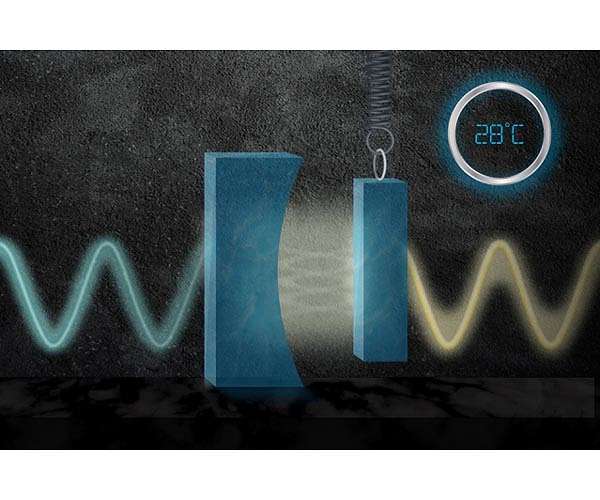
illustration only

Oxford Physicists Reach Fourth-Order Quantum Squeezing With Trapped Ion

by Sophie Jenkins
London, UK (SPX) Jun 03, 2026
Researchers at the University of Oxford have demonstrated a new class of quantum interaction using a single trapped ion, achieving for the first time a fourth-order effect called quadsqueezing. The results, published May 1 in Nature Physics, open a route to quantum effects that were previously too weak to observe in any experimental platform.

The work builds on a well-established quantum technique called squeezing. In quantum mechanics, the precision with which pairs of properties -- such as position and momentum -- can be simultaneously known is constrained by Heisenberg's uncertainty principle. Squeezing redistributes that uncertainty: one property is measured more sharply while the other grows less defined. Squeezed light is already used operationally to boost sensitivity at gravitational-wave detectors, including LIGO.

Ordinary squeezing, however, is just the lowest rung of a broader family of interactions. Physicists have long sought to generate higher-order versions -- trisqueezing and quadsqueezing -- but these effects are naturally very weak, and their strength falls rapidly with increasing order, making them effectively unobservable before noise overwhelms the signal.

The Oxford team resolved this by combining two carefully controlled forces on a single trapped ion rather than attempting to drive a higher-order interaction directly. The approach follows a theoretical proposal by Dr Raghavendra Srinivas and Robert Tyler Sutherland published in 2021. Each force alone produces a simple linear effect, but applied together they exploit non-commutativity -- the property by which two forces alter each other's action -- to generate a much stronger composite interaction in the ion's motion.

"In the lab, non-commuting interactions are often seen as a nuisance because they introduce unwanted dynamics," said lead author Dr Oana Bazavan of Oxford's Department of Physics. "Here, we took the opposite approach and used that feature to generate stronger quantum interactions."

Using the same experimental setup, the team generated squeezing, trisqueezing, and quadsqueezing by adjusting the frequencies, phases, and strengths of the applied forces. Each configuration selectively produced the target interaction while suppressing unwanted higher- or lower-order terms.

The fourth-order quadsqueezing interaction was generated more than 100 times faster than conventional approaches would predict, Dr Bazavan noted -- a speed advantage that puts effects once considered practically unreachable within experimental grasp.

The team verified each interaction by reconstructing the quantum states of motion of the trapped ion. The measurements revealed the distinctive phase-space shapes associated with second-, third-, and fourth-order squeezing, providing a direct experimental signature of each interaction type.

The method is already being extended to more complex multi-mode systems. In combination with mid-circuit measurements of the ion's spin state, it has been used to generate arbitrary superpositions of squeezed states and to simulate a lattice gauge theory -- a class of model central to high-energy physics and condensed matter research.

Because the technique relies on experimental ingredients available across a range of quantum hardware platforms, the Oxford group argues it could serve as a general-purpose route to new forms of quantum simulation, sensing, and computation.

"Fundamentally, we have demonstrated a new type of interaction that lets us explore quantum physics in uncharted territory," said co-author and supervisor Dr Raghavendra Srinivas of the Department of Physics.

Research Report: Squeezing, trisqueezing and quadsqueezing in a hybrid oscillator-spin system

Related Links
University of Oxford
Understanding Time and Space

Subscribe Free To Our Daily Newsletters
Tweet

RELATED CONTENT
The following news reports may link to other Space Media Network websites.
TIME AND SPACE
UMD Physicists Find Crystal Symmetry Controls Nuclear Spin States of Molecular Hydrogen
Los Angeles, CA (SPX) May 01, 2026
Chemical physicists at the University of Maryland have demonstrated that the nuclear spin states of molecular hydrogen can be controlled simply by freezing it inside dry-ice crystals - no magnetic fields or chemical catalysts required. The findings, published in Physical Review Letters on April 29, 2026, open potential paths toward improved hydrogen fuel storage, more stable quantum memory, and sharper astronomical measurements of comet formation temperatures. Molecular hydrogen exists in two nucl ... read more

TIME AND SPACE
NATO intercepts second Iran missile in Turkish airspace

Japan to deploy counter-strike missiles closer to China

Italy to send air-defence aid to Gulf countries; France allowing US aircraft on some Mideast bases

TIME AND SPACE
Turkey says missile launched from Iran destroyed by NATO

TIME AND SPACE
ThinKom Develops Self-Funded Mobile HPM Weapon to Counter Drone Swarms

Hezbollah's fibre-optic drones pose new challenge for Israel

Reliable Robotics Pursues FAA Certification for Network-Agnostic UAS Datalink System

China Moves To Convert Underused Airspace Into A New Industrial Growth Engine

TIME AND SPACE
CACI Wins 231 Million Dollar Task Order for Tactical Satellite Communications to US Special Operations Command

TIME AND SPACE
TIME AND SPACE
Anthropic takes Trump administration to court over Pentagon row

Global arms exports soar on European demand: study

China boosts military spending with eyes on US, Taiwan

TIME AND SPACE
King Charles, Trump toast ties despite Iran tensions

NATO chief says Europeans have 'gotten message' from Trump on defence

China says opposes any targeting of new Iran leader

Four years after banning Russia, FIFA and IOC passive in the face of war

TIME AND SPACE
Ultra-Thin Dual-Mode Shielding Film Blocks Electromagnetic Waves and Neutron Radiation Simultaneously

LMU Munich Solves Two Key Barriers Blocking Perovskite Quantum Dots From Real-World Use

Ultrafast thermal detector pushes gigahertz performance frontier

Subscribe Free To Our Daily Newsletters


The content herein, unless otherwise known to be public domain, are Copyright 1995-2026 - Space Media Network. All websites are published in Australia and are solely subject to Australian law and governed by Fair Use principals for news reporting and research purposes. AFP, UPI and IANS news wire stories are copyright Agence France-Presse, United Press International and Indo-Asia News Service. ESA news reports are copyright European Space Agency. All NASA sourced material is public domain. Additional copyrights may apply in whole or part to other bona fide parties. All articles labeled "by Staff Writers" include reports supplied to Space Media Network by industry news wires, PR agencies, corporate press officers and the like. Such articles are individually curated and edited by Space Media Network staff on the basis of the report's information value to our industry and professional readership. Advertising does not imply endorsement, agreement or approval of any opinions, statements or information provided by Space Media Network on any Web page published or hosted by Space Media Network. General Data Protection Regulation (GDPR) Statement Our advertisers use various cookies and the like to deliver the best ad banner available at one time. All network advertising suppliers have GDPR policies (Legitimate Interest) that conform with EU regulations for data collection. By using our websites you consent to cookie based advertising. If you do not agree with this then you must stop using the websites from May 25, 2018. Privacy Statement. Additional information can be found here at About Us.