
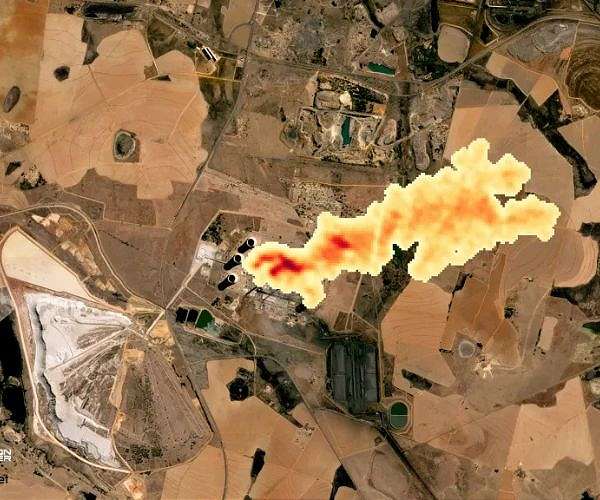
Planet Labs PBC has signed an agreement with Carbon Mapper to design a new specialized version of the Tanager spacecraft optimized exclusively for shortwave infrared (SWIR) detection, targeting significantly enhanced methane and trace gas monitoring from orbit. The Jet Propulsion Laboratory (JPL) is supporting the effort.
The new SWIR-only Tanager is designed to cover five times the area of the existing Tanager satellites, expanding the imagery swath to 100 kilometers while retaining a 30-meter ground sample distance. Unlike the original Tanager-1, which captures a broad spectrum from visible near-infrared through shortwave infrared, the new design focuses solely on the spectral bands most relevant for atmospheric gas detection.
The spacecraft will draw on the Carbon Mapper-led Advanced Emissions Monitoring Imaging Spectrometer (AEMIS) airborne system, developed in partnership with JPL. That system narrows in on the specific spectral bands most effective for detecting methane and other trace gases, and its design principles are being carried over into the satellite architecture.
Slated for launch as early as 2028, the SWIR-only Tanager is intended as a core element of Carbon Mapper's long-planned tiered observing system, which combines aerial and spaceborne assets. The spacecraft is designed to address coverage gaps by providing increased area sweep and spectral precision from orbit, complementing the AEMIS aerial capability already in operation.
Jeff Guido, Vice President of Space Mission Delivery at Planet, said the expanded constellation would "further demonstrate our ability to build cutting-edge spacecraft quickly and efficiently."
Planet has stated it intends to build and deploy at least three additional original-design Tanagers — covering both visible near-infrared and SWIR bands — alongside at least one SWIR-only unit. The two spacecraft variants are expected to complement each other across a range of applications including methane monitoring, biodiversity assessment, water quality, and mineral exploration. Additional commercial use cases cited include fire fuel monitoring and fire source detection.
The original Tanager partnership brought together Planet's satellite manufacturing capabilities, JPL's remote sensing technology, and Carbon Mapper's scientific expertise. Tanager-1 launched in August 2024 and has since detected more than 11,000 methane plumes from nearly 5,000 sources worldwide.
