
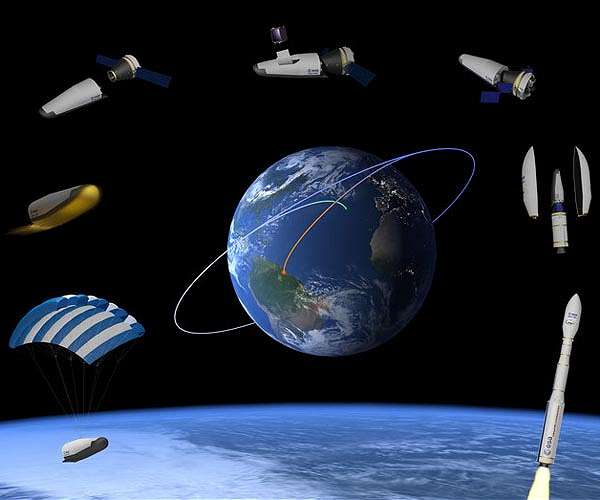
Ceramic tiles and control flaps from Europe's Space Rider reentry module have successfully completed high-temperature testing in a plasma wind tunnel, clearing a major qualification hurdle for the reusable spacecraft's thermal protection and guidance systems.
The tests were conducted at the Italian Aerospace Research Centre (CIRA) facility in Capua, Italy, which operates the world's largest plasma wind tunnel. Components were subjected to temperatures reaching 1600 degrees C, replicating the thermal environment Space Rider will encounter when it reenters the atmosphere after missions in low Earth orbit.
Space Rider is designed to be Europe's first reusable uncrewed spacecraft. The robotic laboratory will remain in orbit for approximately two months per mission, carrying experiments in its cargo bay, before the reentry module detaches and returns to Earth via an automated parafoil glide to a runway landing.
Returning spacecraft hit the upper atmosphere at speeds exceeding 27,000 km/h. At those velocities, atmospheric particles strike the vehicle with sufficient intensity to ionize the surrounding gas, enveloping the craft in a plasma sheath with temperatures that routinely exceed 1600 degrees C.
To withstand those conditions, Space Rider's belly and nose are protected by 21 ceramic tiles made from ISiComp, a material jointly developed by CIRA and Petroceramics. The tiles form a lightweight, resilient thermal skin over the reentry module. They had previously been tested in February under the severe vibration loads generated by a Vega-C rocket's engines, simulated using a 200 kN shaker.
Space Rider's reentry module is distinctive in that it generates aerodynamic lift using its body shape rather than conventional wings, allowing it to target a precise landing point from orbit. Steering during reentry is handled by two flaps, each measuring 90 by 70 centimetres and weighing just 10 kg, which control the 3,000 kg module as it descends at hypersonic speeds. The flaps are fabricated from the same ISiComp ceramic material and are attached via titanium alloy supports produced by additive layer manufacturing. They are commanded by the spacecraft's onboard avionics system.
To simulate flight conditions, CIRA subjected the flaps to an arc jet of gas accelerated to ten times the speed of sound inside the plasma wind tunnel. The tiles were also tested in a deliberately damaged state – with one tile intentionally compromised – to assess the system's resilience to a potential micrometeorite strike during an orbital mission.
Space Rider passed both test campaigns. Further qualification testing of the thermal protection system and guidance system remains before the vehicle is cleared for spaceflight and reentry operations.
