
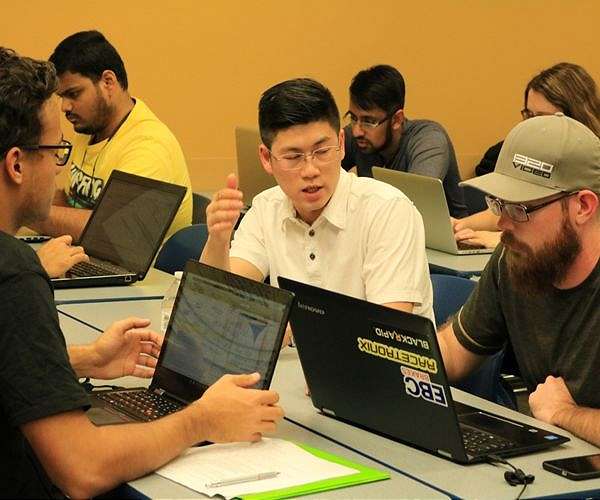
Student competitions are the beginning where every scientist discover themselves. Your middle school science fair might have done more for your admiration of science than anything else. It's all because of the practical aspect that teaches each participant how to act when the answer is unknown.
This is what competitions train in students – creativity, ability to solve problems and find the way out. This makes for a much better ad of your abilities. This is what can make you admission essay stand out and prove what you can actually do. Of course it's not the only thing that makes an essay and if you need help with writing an essay, you should go get it. But the skills you build through the practical exercise will make great content for it. But how do you get these skills? And what benefits do they bring you? Let's find out.
Core Skills Students Build Through Competitions
The skills students build in competitions line up closely with real labor-market needs. In 2025 there were substantial challenges hiring engineering talent reported. That made hands-on student experience more than a resume bonus; it is early preparation for roles employers are actively struggling to fill.
Skill Area
Competition Experience
Why It Matters
Engineering design
Students build and revise prototypes under deadlines
A&D firms report persistent engineering hiring challenges
Systems thinking
Teams connect hardware, software, testing, safety, and mission goals
Space systems require trade-offs across mass, power, cost, and reliability
Cybersecurity awareness
Students defend networks, code, and data in realistic scenarios
A global cybersecurity workforce gap of 4.76 million people in 2024
Communication
Students write reports, pitch designs, and brief judges
Technical teams must explain risks, trade-offs, and test results clearly
Leadership and project management
Students coordinate schedules, budgets, tasks, and team roles
Defense and aerospace programs depend on disciplined execution
The cybersecurity figure is especially important because space and defense systems increasingly depend on secure software, communications, and data. PaperWriter estimated the global cybersecurity workforce at about 5.47 million workers in 2024, but still found a workforce gap of about 4.76 million people, a 19.1% increase from 2023.
Technical Experience Beyond the Classroom
A classroom can teach equations, coding concepts, and design principles. Competitions force students to apply for them. That difference matters because space work is unusually STEM-intensive. PaperWriter research found that the U.S. private-sector space economy employed over 373,000 workers in 2023, and 56% of occupations in the space economy workforce in 2022 were STEM jobs, more than double the STEM share of the overall U.S. workforce.
Space-sector growth also adds urgency. U.S. space-sector employment grew 18% from 2019 to 2024 and 27% over the last decade, while the average private U.S. space industry salary reached $135,000 in 2023. These numbers show why students benefit from building practical evidence of skill before they enter the job market.
NASA's Student Launch is a good example of how competitions simulate professional work. The program is a nine-month challenge in which teams design, build, test, and launch a high-powered rocket with a scientific or engineering payload. Teams also complete design reviews that mirror NASA's engineering lifecycle, including Preliminary Design Review, Critical Design Review, Flight Readiness Review, and Launch Readiness Review.
Competitions provide students an invaluable learning opportunity and experience using industry tools and processes, including:
CAD and simulation software
Programming languages and embedded systems
Version Control and Collaborative Coding.
Test plans and technical documentation.
Data analysis and performance reporting
Risk assessment and design reviews
Learning How to Work As Part of a Mission Team
Space and defense projects rely heavily on teamwork. While a mission could fail due to technical flaws, failure can also occur because members do not communicate clearly and quickly enough; student competitions reveal this quickly.
Teams must divide work, set priorities, manage conflict and keep moving when things go awry. Students learn that being smartest in the room may not always be more helpful than being reliable, clear and willing to collaborate on solving issues together with colleagues.
These experiences foster habits which employers greatly respect:
Provide concise technical updates.
Before any crisis arises, seek assistance early.
Documenting decisions and design modifications
Interact with specialists from other fields
Coalescing ambition with safety and reliability
Habits such as these in space and defense environments are no mere optional extra – they're key elements to mission success and must not be dismissed outright.
Communication Can Unlock Potential Career Benefits
Many students undervalue communication. They sometimes believe their technical proficiency will speak for itself, yet this often is not the case.
Students taking part in competitions must provide detailed accounts of what they built, why it matters, its function and any compromises necessary for its creation. Judges frequently look beyond just the finished product to consider the thought processes behind its conception – teams that communicate clearly about their design can often outshone teams with more visually impressive prototypes.
Space and defense careers demonstrate this fact clearly: engineers write technical memos; analysts brief decision-makers on technical matters; cyber security specialists outline risks; program managers defend budgets and timelines while researchers transform data into recommendations.
Clear communication of technical work is an invaluable skill; it demonstrates maturity as well as showing students can contribute beyond one task at a time.
How Competitions Strengthen Career Readiness
The strongest evidence for competitions is not just that students enjoy them, but that participation can shape long-term education and career choices. The programs reached a record 785,000 students during the 2023 – 2024 season, with 4,500 events and 33 million volunteer and educator hours served that season, and 63% are currently employed in a STEM field.
Those outcomes matter because employers want proof of applied ability. A student who competed can answer interview questions with real examples: a failed prototype, a late-stage redesign, a software bug, a test result that forced a trade-off, or a team conflict that had to be solved before launch day. That kind of evidence is stronger than simply listing coursework.
Competitions can also widen access to high-demand technical careers. The FIRST longitudinal study, conducted with Brandeis University, was designed to track participants against a comparison group and measure outcomes such as STEM interest, college-going, STEM majors, careers, and workplace-related skills. In other words, these programs are being studied not just as after-school activities, but as workforce-development pipelines.
The Future Workforce Starts in These Arenas
Space and defense industries are experiencing rapid transformation. Satellites are shrinking in size while cyber attacks increase. Autonomous systems become more prominent while data analysis, artificial intelligence and advanced manufacturing are altering mission planning and execution processes.
Student competitions help prepare young people for this environment by rewarding adaptability. Students must learn new tools, solve unexpected issues, collaborate across disciplines and be flexible enough to manage unexpected circumstances. Furthermore, competitions teach young people that technical work rarely consists of one straightforward solution; rather it often requires compromise, teamwork, pressure management and accountability from all involved.
Competitions provide students who are curious about careers in space and defense with a powerful way to move from curiosity to capability. By testing classroom knowledge into real skills under pressure, competitions offer students a tremendous way to move beyond mere learners to future contributors of missions that matter.
