
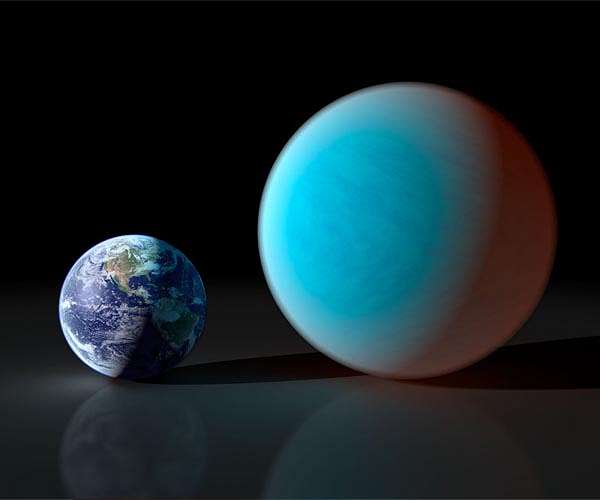
A new study from McMaster University has found that sub-Neptunes – the most common class of planet around Sun-like stars – are nearly absent around mid-to-late M dwarf stars, the most numerous type of star in the Milky Way.
The finding challenges existing models of planet formation and suggests that the physical processes shaping planetary systems differ significantly depending on host-star type.
Sub-Neptunes are worlds thought to resemble a smaller version of Neptune, while super-Earths are rocky planets up to ten times more massive than Earth. Around Sun-like stars, both types are abundant and have been well-documented for nearly a decade. But Sun-like stars account for only a minority of stars in the galaxy. Mid-to-late M dwarfs – stars ranging from eight to 40 per cent the size of the Sun – make up the majority, and until recently their planetary populations have been difficult to characterize due to their faintness.
The McMaster team used data from NASA's Transiting Exoplanet Survey Satellite (TESS) to survey planets around these smaller stars. TESS observes a new patch of sky every 28 days and covers the entire sky over a 26-month cycle, providing the coverage needed to study M dwarf planetary systems at scale.
The analysis revealed that mid-to-late M dwarfs host plenty of super-Earths but almost no sub-Neptunes – a sharp contrast to the pattern seen around Sun-like stars.
"We didn't just refine the picture – we changed it. Around these stars, sub-Neptunes effectively vanish, which means the mechanisms shaping planets here are different," said Erik Gillis, a PhD student in McMaster's Department of Physics and Astronomy and lead author of the study.
Gillis conducted the work under the supervision of Ryan Cloutier, assistant professor and Canada Research Chair in Exoplanetary Astronomy.
One established explanation for the sub-Neptune/super-Earth divide around Sun-like stars is photoevaporation, a process in which intense stellar radiation strips a planet's atmosphere over time. Mid-to-late M dwarfs are highly active and would be expected to drive vigorous photoevaporation – but not to a degree that would account for the near-total disappearance of sub-Neptunes seen in the McMaster data.
Gillis said the scarcity of sub-Neptunes around these stars points instead to differences in how planets form in the first place. Around mid-to-late M dwarfs, planet formation may favour water-rich worlds rather than gas-enveloped sub-Neptunes, a scenario that would have implications for the frequency of potentially habitable environments throughout the galaxy.
"If we want to understand the origins of planets and the origins of life, we need a complete picture of how planets form and what they're made of. This research brings us closer to that," Gillis said.
Cloutier noted the broader significance of expanding planetary surveys beyond the immediate solar neighbourhood. The first confirmed exoplanets were detected only 30 years ago, and the available sample has grown rapidly since. Missions like TESS now allow researchers to compare thousands of planetary systems and look for patterns across different stellar environments.
"It was already astonishing to learn that the most common planets in our galaxy do not exist within our own solar system. Now with this recent work we're developing a clearer picture of where these super-Earths and sub-Neptunes come from," Cloutier said.
The paper was published April 29, 2026, in The Astronomical Journal.
Research Report: TESS Planet Occurrence Rates Reveal the Disappearance of the Radius Valley Around Mid-to-late M Dwarfs
