
Military Space News
ROBO SPACE
AI evolved legged robots reconfigure run and survive damage
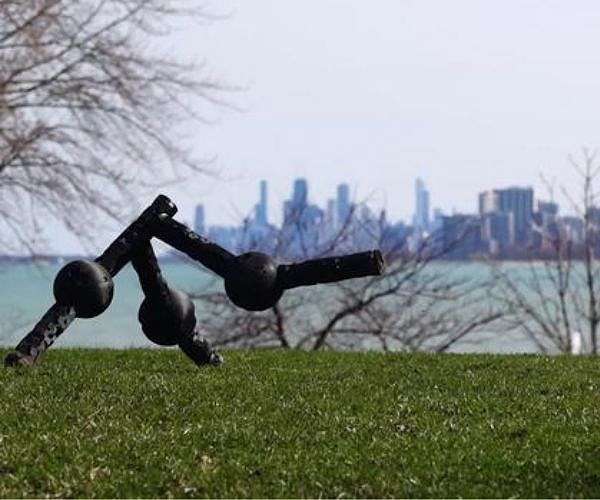
illustration only

AI evolved legged robots reconfigure run and survive damage

by Clarence Oxford
Los Angeles CA (SPX) Mar 09, 2026
Northwestern University engineers have created modular legged robots with what they describe as athletic intelligence, capable of operating outdoors, adapting to damage and reshaping themselves into new configurations as needed. Called legged metamachines, the systems consist of autonomous Lego-like modules that snap together in many combinations, with each module functioning as a complete robot containing its own motor, battery and computer.

Individually, a half meter long module can roll, turn and jump, but the most versatile and resilient behavior emerges when several are connected into a larger machine. Depending on how the modules are arranged, the combined robot undulates like a seal, bounds like a lizard or springs similar to a kangaroo, and it can flip itself upright when overturned, hop over obstacles and perform mid air spins. Because the overall machine is literally a robot made of robots, broken sections do not become dead weight but remain active, continue moving on their own and can later reattach.

To discover effective body designs, the team used artificial intelligence to evolve robot configurations rather than hand designing them around familiar animal like templates. The researchers started from an evolutionary algorithm that imitates natural selection, seeding it with digital models of the modular legs, which resemble a pair of rods joined by a central spherical hub that houses the control electronics, power and actuator. The algorithm was tasked with finding body plans that provided efficient and versatile locomotion and then simulated thousands of candidates, keeping the best performers, discarding weak designs and generating new variants through virtual mutation and recombination.

Over many iterations, this Darwinian style search, accelerated by computation, produced new robotic body shapes that human engineers had not anticipated. In the evolved designs, modular legs can act as legs, spines or tails depending on their position in the larger structure, and the resulting machines coordinate rotation about a single axis at each joint into complex whole body motions. According to the researchers, this process compresses an evolutionary timescale that would take millions or billions of years in nature into minutes or hours of simulation time.

The team then built physical three , four and five legged metamachines that embodied the highest performing evolved designs. In outdoor field trials, these robots ran over rough terrain including gravel, grass, tree roots, leaves, sand, mud and uneven brick surfaces, without requiring elaborate calibration or retraining for each new environment. The machines demonstrated the ability to jump, spin, right themselves when flipped upside down and continue traveling across unstructured ground.

A key result is that the metamachines retain functionality even when damaged. If a leg breaks off, the remaining structure automatically adjusts its gait and continues moving, while the detached module is still able to roll independently and potentially rejoin the group later. The researchers report that every module can sense its surroundings, move, compute and learn, enabling the overall system to be rapidly assembled, repaired, redesigned and recombined while still operating in the field.

The work extends earlier research from the same lab in which an AI algorithm was used to design small soft walking robots from scratch, demonstrating that evolution inspired computation can instantly produce viable machines. Those earlier robots could perform only basic walking on a tabletop and could not sense or coordinate their own bodies, but they showed that AI driven evolution can generate functioning designs markedly different from conventional engineering solutions. The new legged metamachines apply similar principles at larger scale and in more realistic conditions, integrating sensing, control and modular actuation into robust outdoor capable platforms.

By combining physical modularity with AI based design, the researchers argue that robots can be made less like rigid pre programmed tools and more like adaptive systems that behave analogously to evolving life forms. They suggest that such metamachines could be rapidly configured for new tasks or environments and offer inherent resilience for applications where components are likely to fail but the mission must continue. The team frames the project as a step toward machines that do not just survive exposure to the real world but adjust and reorganize themselves in response to it.

Research Report:Agile legged locomotion in reconfigurable modular robots

Related Links
Northwestern University
All about the robots on Earth and beyond!

Subscribe Free To Our Daily Newsletters
RELATED CONTENT
The following news reports may link to other Space Media Network websites.
ROBO SPACE
OpenAI hires creator of 'OpenClaw' AI agent tool
Washington, United States (AFP) Feb 16, 2026
OpenAI has hired the Austrian creator of OpenClaw, an artificial intelligence tool able to execute real-world tasks, the US startup's head Sam Altman said on Sunday. AI agent tool OpenClaw has fascinated - and spooked - the tech world since researcher Peter Steinberger built it in November to help organise his digital life. A Reddit-like pseudo social network for OpenClaw agents called Moltbook, where chatbots converse, has also grabbed headlines and provoked soul-searching over AI. Elon M ... read more

ROBO SPACE
Leonardo DRS infrared payloads selected for SDA Tracking Layer Tranche 3

AST SpaceMobile secures role on MDA SHIELD defense architecture

Greenland is helpful, but not vital, for US missile defense

Netanyahu says Israel won't let Iran restore ballistic missile programme

ROBO SPACE
Hypersonica completes milestone hypersonic missile flight test in Norway

Raytheon advances next generation short range interceptor with ballistic test

Russian strikes kill 4, wound two dozen in Ukraine

Japan and US agree to expand cooperation on missiles, military drills

ROBO SPACE
AALTO plans Zephyr stratospheric hub in northern Australia and seeks local payload partners

Sidekick autonomy software guides YFQ-42A test mission for CCA program

Australian defence firm helps Ukraine zap Russian drones

Drones, sirens, army posters: How four years of war changed a Russian city

ROBO SPACE
MTN to deliver secure SpaceX government satcom for defense customers

EU brings secure GOVSATCOM hub online under GMV leadership

Balerion backs Northwood to tackle ground bottlenecks in expanding space economy

Aalyria spacetime platform tapped for AFRL space data network trials

ROBO SPACE
New electrolyte design aims to make giant flow batteries safer

Aitech and Teledyne expand partnership on space grade SP1 computing platform

Gilat wins 9 million dollar MOD deal for secure defense satcom

Norway buys French bombs for Ukraine: ministry

ROBO SPACE
BAE Systems posts record order backlog as defence spending rises

Canada launches huge defence plan to curb reliance on US

German foreign minister slams France over defence spending

Ukraine, Norway, Sweden top destinations for German arms exports

ROBO SPACE
US to withdraw all troops from Syria: reports

No rift with France, German FM tells AFP as Merz casts doubt on future fighter

French prosecutors announce special team for Epstein files

UK's Starmer urges 'sleeping giant' Europe to curb dependence on US

ROBO SPACE
Carbon fibers bend and straighten under electric control

Engineered substrates sharpen single nanoparticle plasmon spectra

Subscribe Free To Our Daily Newsletters


The content herein, unless otherwise known to be public domain, are Copyright 1995-2026 - Space Media Network. All websites are published in Australia and are solely subject to Australian law and governed by Fair Use principals for news reporting and research purposes. AFP, UPI and IANS news wire stories are copyright Agence France-Presse, United Press International and Indo-Asia News Service. ESA news reports are copyright European Space Agency. All NASA sourced material is public domain. Additional copyrights may apply in whole or part to other bona fide parties. All articles labeled "by Staff Writers" include reports supplied to Space Media Network by industry news wires, PR agencies, corporate press officers and the like. Such articles are individually curated and edited by Space Media Network staff on the basis of the report's information value to our industry and professional readership. Advertising does not imply endorsement, agreement or approval of any opinions, statements or information provided by Space Media Network on any Web page published or hosted by Space Media Network. General Data Protection Regulation (GDPR) Statement Our advertisers use various cookies and the like to deliver the best ad banner available at one time. All network advertising suppliers have GDPR policies (Legitimate Interest) that conform with EU regulations for data collection. By using our websites you consent to cookie based advertising. If you do not agree with this then you must stop using the websites from May 25, 2018. Privacy Statement. Additional information can be found here at About Us.