
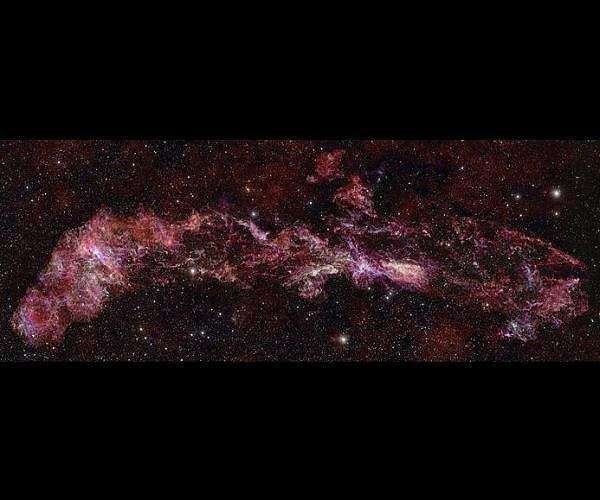
Astronomers have produced the largest image ever made with the Atacama Large Millimeter/submillimeter Array (ALMA), revealing an intricate web of cold molecular gas at the heart of the Milky Way. Covering more than 650 light years across the galaxy's Central Molecular Zone, the new map exposes a dense, filamentary network of material feeding the supermassive black hole and surrounding star-forming clouds.
The survey, known as the ALMA CMZ Exploration Survey (ACES), targets the cold molecular gas that provides the raw material for new stars. By stitching together many individual ALMA pointings into a single mosaic as long as three full Moons laid side by side on the sky, the team captured structures ranging in size from clouds spanning dozens of light years down to compact clumps around individual stars.
The ACES data reveal the complex chemistry of the Central Molecular Zone, detecting dozens of different molecules. These range from relatively simple species such as silicon monoxide and sulphur monoxide to more complex organic molecules including methanol, acetone and ethanol, allowing astronomers to trace different physical conditions and processes within the gas.
Cold gas in the region flows along narrow filaments that channel material into denser clumps where stars can form. While astronomers understand this process reasonably well in the quieter outskirts of the Milky Way, the new map shows that conditions in the central region are far more extreme, with higher densities, stronger radiation fields and more violent feedback from massive stars.
"The CMZ hosts some of the most massive stars known in our galaxy, many of which live fast and die young, ending their lives in powerful supernova explosions, and even hypernovae," says ACES leader Steve Longmore of Liverpool John Moores University. By relating the filamentary gas structures to these massive stars and their remnants, the team aims to test whether standard theories of star formation still apply under such harsh conditions.
Because the Milky Way's nucleus is the only galactic center close enough to study in such detail, it serves as a key reference point for understanding more distant systems. "By studying how stars are born in the CMZ, we can also gain a clearer picture of how galaxies grew and evolved," says Longmore, noting that the region appears to share many features with galaxies in the early Universe where star formation occurred in similarly chaotic environments.
The survey has already surprised astronomers with the richness of structure in the gas. "We anticipated a high level of detail when designing the survey, but we were genuinely surprised by the complexity and richness revealed in the final mosaic," says Katharina Immer, an ALMA astronomer at ESO. The ACES data are being presented in a coordinated series of six papers accepted or under final review for publication in Monthly Notices of the Royal Astronomical Society.
ACES is a large international collaboration involving more than 160 scientists at over 70 institutions across Europe, the Americas, Asia and Australia. The project required an extensive data-reduction effort to calibrate and combine the many ALMA observations into a consistent dataset, led by a dedicated working group coordinating contributors from multiple countries.
The new map also highlights the power of ALMA as a facility for surveying large, complex regions in the millimetre and submillimetre regime. This ACES mosaic is the first time such a wide area of the Milky Way's center has been imaged with ALMA at this level of detail, demonstrating the array's ability to link small-scale star-forming cores to the larger-scale flows of gas that feed them.
Looking ahead, astronomers expect to push even deeper into the Milky Way's core with future upgrades and new facilities. "The upcoming ALMA Wideband Sensitivity Upgrade, along with ESO's Extremely Large Telescope, will soon allow us to push even deeper into this region – resolving finer structures, tracing more complex chemistry, and exploring the interplay between stars, gas and black holes with unprecedented clarity," says Ashley Barnes of ESO. "In many ways, this is just the beginning."
The ACES data products will be made publicly available through the ALMA Science Portal, giving the wider community access to the detailed maps of molecular emission lines and continuum emission in the Central Molecular Zone. These datasets will support further studies of topics ranging from gas dynamics around the central black hole to the impact of stellar feedback on the surrounding interstellar medium.
