
About 15 percent of asteroids near Earth have small moons orbiting them, making binary asteroid systems common close to our planet. A new analysis of images from NASA's Double Asteroid Redirection Test (DART) spacecraft now shows that these systems can exchange material in slow motion collisions over millions of years, reshaping their surfaces and influencing how they evolve.
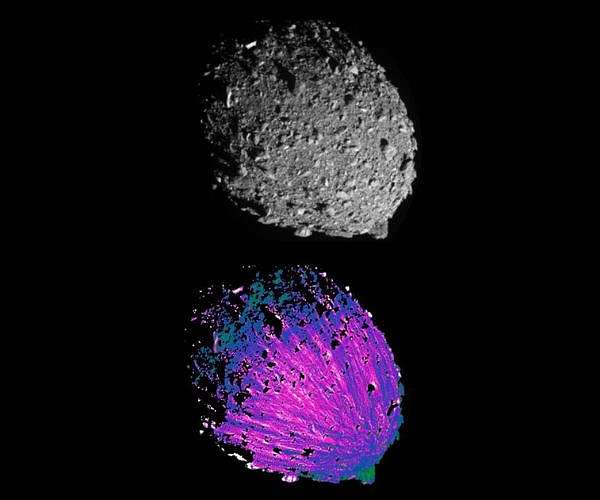
A team led by the University of Maryland examined high resolution images that DART captured just before it deliberately impacted the small asteroid moon Dimorphos in 2022. In those final frames, after careful processing, they identified bright fan shaped streaks across the surface of Dimorphos that mark where low velocity projectiles struck the moon after traveling from its larger companion asteroid, Didymos. The researchers report that these patterns provide the first direct visual evidence that rocks and dust naturally move between the two bodies in the binary system.
The findings, published March 6, 2026, in The Planetary Science Journal under the title "Evidence of Recent Material Transport within a Binary Asteroid System," indicate that the Didymos Dimorphos pair is more active than previously appreciated. Lead author Jessica Sunshine, a professor with joint appointments in the University of Maryland's Department of Astronomy and Department of Geological, Environmental, and Planetary Sciences, said the team initially suspected an instrumental or processing problem when they first saw the unusual patterns. After they refined their techniques and removed lighting artifacts, they concluded that the streaks are consistent with low velocity impacts from what they describe as "cosmic snowballs" of material shed from Didymos.
The work also provides the first visual confirmation of the Yarkovsky O'Keefe Radzievskii Paddak (YORP) effect in action on a small asteroid. In the YORP effect, uneven heating from sunlight causes small asteroids to spin faster over time until loose material flies off their surfaces and can accumulate to form moons. Sunshine and her colleagues argue that this process likely produced the Didymos Dimorphos system and that the fan like markings on Dimorphos record where shed material from Didymos landed on the smaller body.
Revealing those markings required months of detailed image processing. DART's approach trajectory created an unusual challenge for interpretation because the spacecraft flew almost straight toward Dimorphos with little change in viewing geometry or illumination. To separate real surface features from lighting effects, UMD astronomy research scientist Tony Farnham and former postdoctoral researcher Juan Rizos developed methods to subtract shadows cast by boulders and to correct for subtle brightness variations across the surface. When those corrections were applied, a network of rays wrapping around Dimorphos emerged from the data.
The team then tested whether these rays could simply be due to the position of the Sun relative to the spacecraft. By mapping each streak back to its apparent source region, they found that the features all originated in a specific area near the edge of Dimorphos that is offset from the sub solar point where the Sun was overhead. As they refined a three dimensional model of Dimorphos, the fan shaped streaks became clearer rather than fading, which strengthened the case that they represent actual deposits of material delivered from Didymos rather than artifacts of illumination.
Further dynamical calculations, led by University of Maryland alum Harrison Agrusa, showed that the material left Didymos at about 30.7 centimeters per second, which is slower than the average human walking speed. At these speeds, incoming clumps of dust and rock tend not to excavate classic craters. Instead, Sunshine explained, their gentle impacts create asymmetric deposits that spread out in fans, consistent with the observed ray patterns concentrated near the equator of Dimorphos where models predict spun off material from Didymos should land.
To validate this interpretation, the researchers carried out impact experiments at the University of Maryland's Institute for Physical Science and Technology. In the laboratory, former postdoctoral associate Esteban Wright and collaborators dropped marbles into sand mixed with painted gravel intended to mimic boulders on Dimorphos. High speed cameras recorded how the impacts sent material streaming between and around the gravel pieces. The presence of boulders blocked some ejecta while channeling other particles into rays, producing fan like patterns that closely resembled the streaks seen on Dimorphos in the DART images.
Complementary computer simulations at Lawrence Livermore National Laboratory explored impacts by both compact rocks and looser clumps of dust, similar to the hypothesized "cosmic snowballs" moving between Didymos and Dimorphos. Those simulations showed that boulder covered surfaces naturally sculpt incoming material into narrow rays regardless of whether the impactor is a solid object or an aggregate of grains. The combination of numerical models, laboratory experiments, and spacecraft imagery supports the conclusion that Dimorphos' surface records ongoing exchanges of material within the binary asteroid system at very low speeds.
Because the DART spacecraft captured its images just before it crashed into Dimorphos, the new results show that material exchange between Didymos and its moon was already underway before the impact. Sunshine noted that the fan like deposits should extend onto the hemisphere that DART did not strike and that some of these features may have survived the collision. The upcoming European Space Agency Hera mission, scheduled to arrive at Didymos in December 2026, will be able to search for remnants of the pre impact rays and for any new patterns created by boulders that DART dislodged.
Hera's close up survey of the system could reveal how much the DART impact altered Dimorphos' surface and whether the ongoing "cosmic snowball" traffic continues to shape the moon after such a major event. By comparing Hera's observations with the pre impact DART data and the team's models, scientists hope to refine their understanding of how binary asteroids respond to both natural processes and deliberate deflection attempts. Those insights are directly relevant to planetary defense strategies that aim to gently nudge potentially hazardous asteroids off Earth crossing trajectories.
Research Report:Evidence of Recent Material Transport within a Binary Asteroid System
