
Military Space News
SPACEWAR
Fake AI satellite imagery spurs US-Iran war disinformation

Fake AI satellite imagery spurs US-Iran war disinformation

By Anuj CHOPRA
Washington, United States (AFP) Mar 9, 2026
The satellite image posted by an Iranian news outlet looked real: a devastated US base in Qatar. But it was an AI-generated fake, underscoring the accelerating threat of tech-enabled disinformation during wartime.

The rise of generative AI has turbocharged the ability of state actors and propagandists to fabricate convincing satellite imagery during major conflicts, a trend that researchers warn carries real-world security implications.

As the US-Israeli war against Iran rages, Tehran Times, a state-aligned English daily, posted on X a "before vs. after" image it claimed showed "completely destroyed" US radar equipment at a base in Qatar.

In fact it was an AI-manipulated version of a Google Earth image from last year of a US base in Bahrain, researchers said.

The subtle visual giveaways included a row of cars parked in identical positions in both the authentic satellite photo and the manipulated image.

Yet the manipulated photo garnered millions of views as it spread across social media in multiple languages, illustrating how users are increasingly failing to distinguish reality from fiction on platforms saturated with AI-generated visuals.

Brady Africk, an open-source intelligence researcher, noted an "increase in manipulated satellite imagery" appearing on social media in the wake of major events including the Middle East war.

"Many of these manipulated images have the hallmarks of imperfect AI-generation: odd angles, blurred details, and hallucinated features that don't align with reality," Africk told AFP.

"Others appear to be an image manipulated manually, often by superimposing indicators of damage or another change on a satellite image that had no such details to begin with," he said.

- 'Fog of war' -

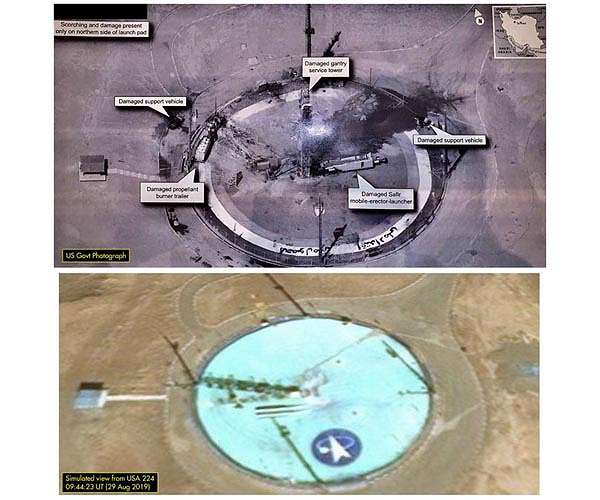
Information warfare analyst Tal Hagin flagged another AI-generated satellite image purporting to show that Israeli-US jets had targeted the painted silhouette of an aircraft on the ground in Iran, while Tehran seemingly moved real planes elsewhere.

The telltale clues included gibberish coordinates embedded in the fake image, which spread across sites including Instagram, Threads and X.

AFP detected a SynthID, an invisible watermark meant to identify images created using Google AI.

The fabricated satellite images follow the emergence of imposter OSINT -- or open-source intelligence -- accounts on social media that appear to undermine the work of credible digital investigators.

"Due to the fog of war, it can be very difficult to determine the success of an adversary's strikes. OSINT came as a solution, using public satellite imagery to circumvent the censorship" inside countries like Iran, Hagin said.

"But it's now being preyed upon by disinformation agents," he added.

Reports of fake satellite imagery created or edited using AI also followed the Russia-Ukraine conflict and the four-day war between India and Pakistan last year.

- 'Critical awareness' -

"Manipulated satellite imagery, like other forms of misinformation, can have real-world impacts when people act on the information they come across without verifying its authenticity," Africk said.

"This can have effects that range from influencing public opinion on a major issue, like whether or not a country should engage in conflict, to impacting financial markets."

In the age of AI, authentic high-resolution satellite imagery collected in real time can give decision-makers vital clues to assess security threats and debunk falsehoods from unverified sources.

During a recent militant attack on Niamey airport in Niger, satellite intelligence company Vantor said it detected images circulating online purporting to show the main civilian terminal on fire.

The company's own satellite imagery helped confirm that the photos were fake, almost certainly generated using AI, Vantor's Tomi Maxted told AFP.

"When a satellite image is presented as visual evidence in the context of war, it can easily influence how people interpret events," Bo Zhao, from the University of Washington, told AFP.

As AI-generated imagery grows increasingly convincing, it is "important for the public to approach such visual content with caution and critical awareness," Zhao said.

ac/js

GOOGLE

Related Links
Military Space News at SpaceWar.com

Subscribe Free To Our Daily Newsletters
RELATED CONTENT
The following news reports may link to other Space Media Network websites.
SPACEWAR
US 'not concerned' by reports Russia aiding Iran's targeting
Washington, United States (AFP) Mar 7, 2026
US Defense Secretary Pete Hegseth said Friday that the United States is "not concerned" about reports that Russia is providing intelligence to Iran on US troop positions and movements. While declining to confirm the reports, Hegseth, in an interview with CBS's "60 Minutes," said: "We're tracking everything." "Our commanders are aware of everything," he said. "We have the best intelligence in the world. We're aware of who's talking to who." "We're not concerned about that," the defense secret ... read more

SPACEWAR
Italy to send air-defence aid to Gulf countries; France allowing US aircraft on some Mideast bases

Leonardo DRS infrared payloads selected for SDA Tracking Layer Tranche 3

AST SpaceMobile secures role on MDA SHIELD defense architecture

Greenland is helpful, but not vital, for US missile defense

SPACEWAR
Hypersonica completes milestone hypersonic missile flight test in Norway

Raytheon advances next generation short range interceptor with ballistic test

Russian strikes kill 4, wound two dozen in Ukraine

Japan and US agree to expand cooperation on missiles, military drills

SPACEWAR
EU's Kallas warns anti-drone stock 'limited' as Mideast, Ukraine wars rage

Azerbaijan says Iran drone attack 'will not go unanswered'

Drone strikes on Sudan markets kill 33: medical source

Saudi Arabia intercepts drone attack targeting huge refinery: defence ministry

SPACEWAR
MTN to deliver secure SpaceX government satcom for defense customers

EU brings secure GOVSATCOM hub online under GMV leadership

Balerion backs Northwood to tackle ground bottlenecks in expanding space economy

Aalyria spacetime platform tapped for AFRL space data network trials

SPACEWAR
New electrolyte design aims to make giant flow batteries safer

Aitech and Teledyne expand partnership on space grade SP1 computing platform

Gilat wins 9 million dollar MOD deal for secure defense satcom

Norway buys French bombs for Ukraine: ministry

SPACEWAR
Global arms exports soar on European demand: study

China boosts military spending with eyes on US, Taiwan

BAE Systems posts record order backlog as defence spending rises

Canada launches huge defence plan to curb reliance on US

SPACEWAR
Vibes war? Trump pitches Iran conflict on 'feeling'

Mojtaba Khamenei: son and successor to Iran's supreme leader

China FM blasts Middle East war, urges US to manage ties

Starmer and Trump hold call about Iran war

SPACEWAR
Carbon fibers bend and straighten under electric control

Engineered substrates sharpen single nanoparticle plasmon spectra

Subscribe Free To Our Daily Newsletters


The content herein, unless otherwise known to be public domain, are Copyright 1995-2026 - Space Media Network. All websites are published in Australia and are solely subject to Australian law and governed by Fair Use principals for news reporting and research purposes. AFP, UPI and IANS news wire stories are copyright Agence France-Presse, United Press International and Indo-Asia News Service. ESA news reports are copyright European Space Agency. All NASA sourced material is public domain. Additional copyrights may apply in whole or part to other bona fide parties. All articles labeled "by Staff Writers" include reports supplied to Space Media Network by industry news wires, PR agencies, corporate press officers and the like. Such articles are individually curated and edited by Space Media Network staff on the basis of the report's information value to our industry and professional readership. Advertising does not imply endorsement, agreement or approval of any opinions, statements or information provided by Space Media Network on any Web page published or hosted by Space Media Network. General Data Protection Regulation (GDPR) Statement Our advertisers use various cookies and the like to deliver the best ad banner available at one time. All network advertising suppliers have GDPR policies (Legitimate Interest) that conform with EU regulations for data collection. By using our websites you consent to cookie based advertising. If you do not agree with this then you must stop using the websites from May 25, 2018. Privacy Statement. Additional information can be found here at About Us.