
Military Space News
STELLAR CHEMISTRY
Mauve satellite marks new step for commercial ultraviolet astronomy
illustration only

Mauve satellite marks new step for commercial ultraviolet astronomy

by Clarence Oxford
Los Angeles CA (SPX) Mar 11, 2026
Mauve, described as the world's first commercial space science satellite, has achieved first light and returned its initial astronomical data to researchers. The mission is designed to give scientists direct access to space based observations through a small, privately funded ultraviolet and visible light telescope.

Built and operated by UK based Blue Skies Space Ltd, which was co founded by current staff and alumni at King's College London, Mauve carries a 13 cm spectrophotometric telescope. The instrument measures how the intensity of light from stars varies with wavelength, allowing astronomers to study stellar properties and activity in detail.

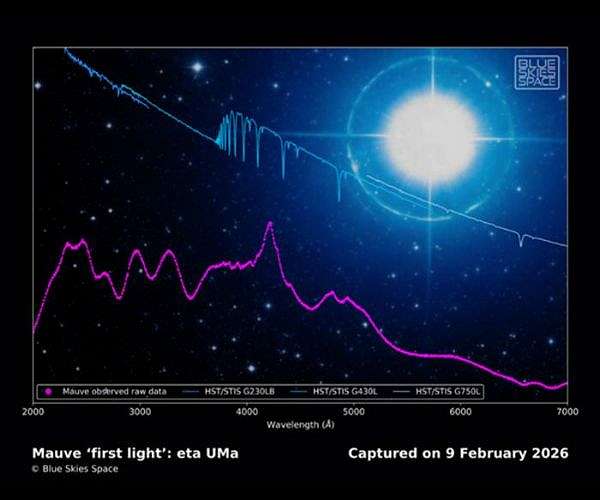
For its first light observation on 9 February 2026, Mauve targeted Eta UMa, a hot, blue white star around 104 light years away in the constellation Ursa Major, also known as the Great Bear. In a single 5 second integration, the satellite recorded the star's spectrum in the ultraviolet, which can be compared directly with archival Hubble Space Telescope STIS spectra of the same object.

Eta UMa emits strongly in the ultraviolet, making it a useful calibration source for a mission focused on this part of the spectrum. By matching Mauve's measurements against well studied Hubble data, the team can validate the new satellite's performance and refine its data processing pipelines before moving on to a broader observing program.

Blue Skies Space positions Mauve as a pathfinder for a fleet of small, agile space telescopes built and launched at lower cost and on shorter timescales than traditional missions. The company aims to deliver high quality space science data directly to the global research community, lowering barriers to participation in space based astronomy.

Professor Giovanna Tinetti, Vice Dean (Research) in the Faculty of Natural, Mathematical and Engineering Sciences at King's College London and a co founder of Blue Skies Space, highlighted the scientific significance of seeing Mauve's first spectrum. She described the launch as emotional after years of work, and said the real excitement comes from the prospect of doing science with what she called the first privately funded space science mission.

Chief executive and co founder Dr Marcell Tesseny, an alumnus of the King's Department of Physics, said the first light result demonstrates the company's vision to serve the space science community. He emphasised that Blue Skies Space was founded to provide access to space science data worldwide using constellations of compact satellites.

Over its planned three year mission, Mauve will focus on how stellar magnetic activity and flares affect the environments of nearby exoplanets, potentially influencing their habitability. By monitoring stars in ultraviolet and visible light, the satellite will help researchers trace how energetic events from host stars impact planetary atmospheres and long term evolutionary pathways.

The mission will also investigate early stage planetary evolution and test aspects of gravity theory by observing binary star systems where the motions of paired stars can reveal subtle gravitational effects. In addition, Mauve's long term monitoring will feed into studies of how stars live and die, building a broader picture of stellar life cycles across different masses and ages.

Related Links
Blue Skies Space Ltd
Stellar Chemistry, The Universe And All Within It

Subscribe Free To Our Daily Newsletters
RELATED CONTENT
The following news reports may link to other Space Media Network websites.
STELLAR CHEMISTRY
Superheavy-lift rockets like SpaceX's Starship could transform astronomy by making space telescopes cheaper
Washington DC (SPX) Jan 10, 2026
After a string of dramatic failures, the huge Starship rocket from SpaceX had a fully successful test on Oct. 13, 2025. A couple more test flights, and SpaceX plans to launch it into orbit. A month later, a rival rocket company, Blue Origin, flew its almost-as-large New Glenn rocket all the way to orbit and sent spacecraft on their way to Mars. While these successful flights are exciting news for future missions to the Moon as well as other planets, I've argued for several years that these s ... read more

STELLAR CHEMISTRY
NATO intercepts second Iran missile in Turkish airspace

Japan to deploy counter-strike missiles closer to China

Italy to send air-defence aid to Gulf countries; France allowing US aircraft on some Mideast bases

Leonardo DRS infrared payloads selected for SDA Tracking Layer Tranche 3

STELLAR CHEMISTRY
Turkey says missile launched from Iran destroyed by NATO

Hypersonica completes milestone hypersonic missile flight test in Norway

Raytheon advances next generation short range interceptor with ballistic test

Russian strikes kill 4, wound two dozen in Ukraine

STELLAR CHEMISTRY
EU's Kallas warns anti-drone stock 'limited' as Mideast, Ukraine wars rage

Zelensky says 11 countries asking Ukraine for drone help against Iran

Drone strikes on Sudan markets kill 33: medical source

EDA taps Airbus to broaden Capa-X drone mission roles

STELLAR CHEMISTRY
MTN to deliver secure SpaceX government satcom for defense customers

EU brings secure GOVSATCOM hub online under GMV leadership

Balerion backs Northwood to tackle ground bottlenecks in expanding space economy

Aalyria spacetime platform tapped for AFRL space data network trials

STELLAR CHEMISTRY
New electrolyte design aims to make giant flow batteries safer

Aitech and Teledyne expand partnership on space grade SP1 computing platform

Gilat wins 9 million dollar MOD deal for secure defense satcom

Norway buys French bombs for Ukraine: ministry

STELLAR CHEMISTRY
Anthropic takes Trump administration to court over Pentagon row

Global arms exports soar on European demand: study

China boosts military spending with eyes on US, Taiwan

BAE Systems posts record order backlog as defence spending rises

STELLAR CHEMISTRY
Vibes war? Trump pitches Iran conflict on 'feeling'

China says opposes any targeting of new Iran leader

Four years after banning Russia, FIFA and IOC passive in the face of war

Mojtaba Khamenei: son and successor to Iran's supreme leader

STELLAR CHEMISTRY
Carbon fibers bend and straighten under electric control

Engineered substrates sharpen single nanoparticle plasmon spectra

Subscribe Free To Our Daily Newsletters


The content herein, unless otherwise known to be public domain, are Copyright 1995-2026 - Space Media Network. All websites are published in Australia and are solely subject to Australian law and governed by Fair Use principals for news reporting and research purposes. AFP, UPI and IANS news wire stories are copyright Agence France-Presse, United Press International and Indo-Asia News Service. ESA news reports are copyright European Space Agency. All NASA sourced material is public domain. Additional copyrights may apply in whole or part to other bona fide parties. All articles labeled "by Staff Writers" include reports supplied to Space Media Network by industry news wires, PR agencies, corporate press officers and the like. Such articles are individually curated and edited by Space Media Network staff on the basis of the report's information value to our industry and professional readership. Advertising does not imply endorsement, agreement or approval of any opinions, statements or information provided by Space Media Network on any Web page published or hosted by Space Media Network. General Data Protection Regulation (GDPR) Statement Our advertisers use various cookies and the like to deliver the best ad banner available at one time. All network advertising suppliers have GDPR policies (Legitimate Interest) that conform with EU regulations for data collection. By using our websites you consent to cookie based advertising. If you do not agree with this then you must stop using the websites from May 25, 2018. Privacy Statement. Additional information can be found here at About Us.