
Military Space News
TECH SPACE
'Miracle': Europe reconnects with lost spacecraft

'Miracle': Europe reconnects with lost spacecraft

by AFP Staff Writers
Paris, France (AFP) Mar 19, 2026
The European Space Agency announced Thursday it has re-established communication with a spacecraft that is part of its Proba-3 mission, after losing contact with the satellite a month ago.

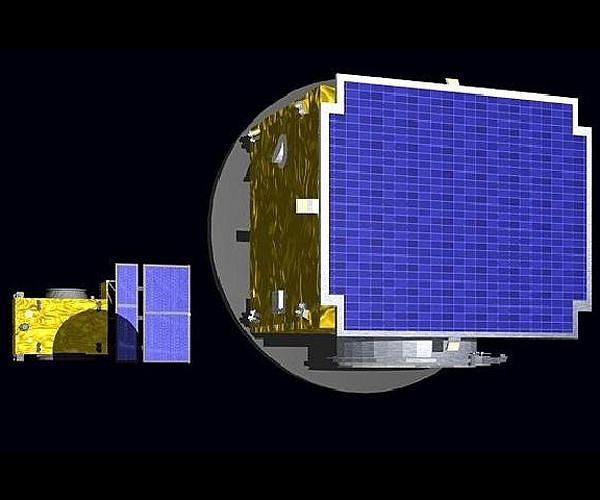
Proba-3, which launched on a two-year mission in 2024, uses two spacecraft flying in precise formation to simulate a solar eclipse more than 60,000 kilometres (37,000 miles) above Earth.

Scientists have used this delicate dance to get a rare glimpse of the Sun's little-known outer atmosphere, which is called the corona.

One satellite has a 1.4-metre (five-foot) shield that plays the role of the Moon in blocking the Sun's light, while the other observes the corona from the shadow.

However something happened to the second spacecraft, which has the crucial coronagraph instrument, on February 14.

A chain reaction led to the spacecraft losing its orientation, causing its solar panel to face away from the Sun, draining the batteries.

The spacecraft then entered survival mode -- it has been silently floating through space since.

However overnight "some miracle happened because we reconnected with the spacecraft," ESA director Josef Aschbacher said on Thursday.

The other spacecraft -- the one with the shield -- had been "following and observing" its lost twin, he told a press conference held after an ESA Council meeting.

The lost spacecraft had been "tumbling" when an ESA team in Spain "saw that some sunlight is actually hitting the solar panels," Aschbacher explained.

They seized the chance, using this small amount of power to re-establish a connection.

The spacecraft's solar panel is now facing the Sun, allowing it to charge its batteries.

Next ESA experts will switch the instruments back on and carry out tests to find out how much damage has been done.

"Hearing back from the coronagraph is amazing news, and a great relief!" Proba-3 mission manager Damien Galano said in a statement.

The Sun's corona, which is several million kilometres thick, still remains little understood. Invisible to the naked eye and telescopes, it is normally hidden by the bright light coming from the Sun.

While total eclipses on Earth last just minutes and only occur around 60 times a century, Proba-3 is capable of securing 10 to 12 hours of observations a week over two years, according to the ESA.

Related Links
Space Technology News - Applications and Research

Subscribe Free To Our Daily Newsletters
RELATED CONTENT
The following news reports may link to other Space Media Network websites.
TECH SPACE
Behind Space Innovation The Growing Role of Outsourcing Services
Los Angeles CA (SPX) Mar 11, 2026
Explore the reasons outsourcing has become the norm in space innovation. Discover how it helps teams reduce turnaround times, lower costs and improve results within a short time. ... read more

TECH SPACE
NATO intercepts second Iran missile in Turkish airspace

Japan to deploy counter-strike missiles closer to China

Italy to send air-defence aid to Gulf countries; France allowing US aircraft on some Mideast bases

Leonardo DRS infrared payloads selected for SDA Tracking Layer Tranche 3

TECH SPACE
Turkey says missile launched from Iran destroyed by NATO

Hypersonica completes milestone hypersonic missile flight test in Norway

Raytheon advances next generation short range interceptor with ballistic test

Russian strikes kill 4, wound two dozen in Ukraine

TECH SPACE
Hawk shape shifting in flight may guide future drone control

EU's Kallas warns anti-drone stock 'limited' as Mideast, Ukraine wars rage

Airspan extends 5G in motion to defense aerial networks

Zelensky says 11 countries asking Ukraine for drone help against Iran

TECH SPACE
MTN to deliver secure SpaceX government satcom for defense customers

EU brings secure GOVSATCOM hub online under GMV leadership

Balerion backs Northwood to tackle ground bottlenecks in expanding space economy

Aalyria spacetime platform tapped for AFRL space data network trials

TECH SPACE
New electrolyte design aims to make giant flow batteries safer

Aitech and Teledyne expand partnership on space grade SP1 computing platform

Gilat wins 9 million dollar MOD deal for secure defense satcom

Norway buys French bombs for Ukraine: ministry

TECH SPACE
Anthropic takes Trump administration to court over Pentagon row

Global arms exports soar on European demand: study

China boosts military spending with eyes on US, Taiwan

BAE Systems posts record order backlog as defence spending rises

TECH SPACE
Vibes war? Trump pitches Iran conflict on 'feeling'

China says opposes any targeting of new Iran leader

Four years after banning Russia, FIFA and IOC passive in the face of war

Mojtaba Khamenei: son and successor to Iran's supreme leader

TECH SPACE
Ultrafast thermal detector pushes gigahertz performance frontier

Carbon fibers bend and straighten under electric control

Engineered substrates sharpen single nanoparticle plasmon spectra

Subscribe Free To Our Daily Newsletters


The content herein, unless otherwise known to be public domain, are Copyright 1995-2026 - Space Media Network. All websites are published in Australia and are solely subject to Australian law and governed by Fair Use principals for news reporting and research purposes. AFP, UPI and IANS news wire stories are copyright Agence France-Presse, United Press International and Indo-Asia News Service. ESA news reports are copyright European Space Agency. All NASA sourced material is public domain. Additional copyrights may apply in whole or part to other bona fide parties. All articles labeled "by Staff Writers" include reports supplied to Space Media Network by industry news wires, PR agencies, corporate press officers and the like. Such articles are individually curated and edited by Space Media Network staff on the basis of the report's information value to our industry and professional readership. Advertising does not imply endorsement, agreement or approval of any opinions, statements or information provided by Space Media Network on any Web page published or hosted by Space Media Network. General Data Protection Regulation (GDPR) Statement Our advertisers use various cookies and the like to deliver the best ad banner available at one time. All network advertising suppliers have GDPR policies (Legitimate Interest) that conform with EU regulations for data collection. By using our websites you consent to cookie based advertising. If you do not agree with this then you must stop using the websites from May 25, 2018. Privacy Statement. Additional information can be found here at About Us.