
Military Space News
ROBO SPACE
NASA humanoid robot completes decade-long Edinburgh mission
illustration only

NASA humanoid robot completes decade-long Edinburgh mission

by Sophie Jenkins
London, UK (SPX) Mar 11, 2026
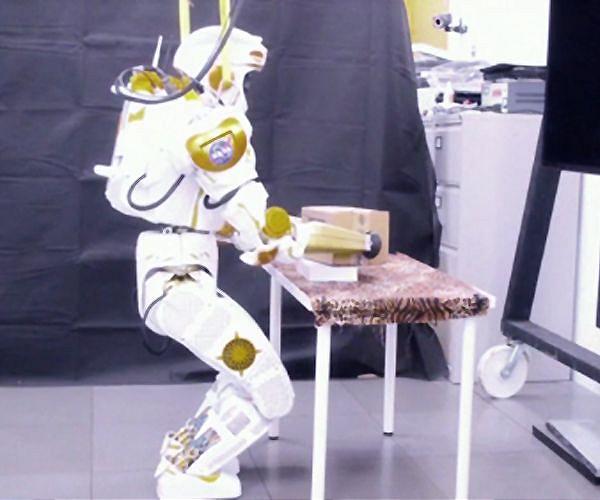
A NASA humanoid robot that helped pioneer advanced walking and manipulation capabilities for future Mars missions has returned to the United States after a 10 year deployment in Scotland. The robot, known as Valkyrie, has been based at the University of Edinburgh under a long term lease agreement with NASA's Johnson Space Center in Texas.

Valkyrie is a human sized platform standing about 1.8 meters tall and weighing approximately 125 kilograms. The system features a human like form factor so it can work alongside people and carry out high risk tasks in locations that may be hazardous or inaccessible to human operators.

NASA originally developed Valkyrie as a technology testbed for missions that would send robots to Mars years before human crews. The agency envisaged humanoid systems like Valkyrie performing pre deployment duties and maintaining infrastructure and assets on the Martian surface ahead of astronaut landings.

When the platform arrived in Edinburgh in 2016 it was one of the most advanced humanoid robots in the world. It was also the only Valkyrie unit outside the United States and one of only three prototypes ever built, making its presence in the UK a rare asset for robotics research.

On delivery, Valkyrie could walk on flat terrain and execute basic tasks such as holding and manipulating objects. Over the past decade, researchers at the Edinburgh Centre for Robotics significantly expanded these capabilities using artificial intelligence and machine learning techniques to help the robot interpret and respond to complex environments.

Teams improved Valkyrie's handling and walking performance, enabling more robust motion over uneven or unpredictable surfaces. They also enhanced how the robot fuses information from its onboard sensors so it can better understand its surroundings and move safely in close proximity to people.

The research program focused on whole body manipulation and perception in humanoid robots. Scientists worked on methods that allow Valkyrie to adapt to changing conditions using data driven control, and to link what the robot sees directly to how it plans and executes movements fast enough to operate in real world scenarios.

Work with Valkyrie took place at the Edinburgh Centre for Robotics, a joint initiative between the University of Edinburgh and Heriot Watt University. Dozens of PhD students and researchers used the platform to advance humanoid control, motion planning and perception, helping to train a generation of specialists in the field.

The project received support from the Engineering and Physical Sciences Research Council, part of UK Research and Innovation. This backing helped sustain long term experimentation required to refine learning based planning and control methods for complex humanoid systems.

Reflecting on the program, former University of Edinburgh student and current Touchlab Chief Technical Officer Dr Vladimir Ivan described hosting Valkyrie as a rare opportunity at a time when few humanoid prototypes were available worldwide. He said the robot enabled fundamental advances in mobility and stability research and helped establish Edinburgh as a robotics hub with world class research and a growing ecosystem of robotics businesses.

Humanoid robotics research in Edinburgh will continue using Talos, a 1.75 meter tall platform the University acquired in 2020. Scientists employ Talos to study how robots walk, maintain balance, use tools and apply machine learning to adapt to dynamic, human centric environments through dyadic human interaction.

Advances from the Talos program and related work could support applications in assisted living, healthcare and other domains where robots collaborate closely with people. Researchers aim to translate lessons learned from Valkyrie and Talos into safer, more capable humanoid systems for both space and terrestrial use.

Professor Sethu Vijayakumar, Personal Chair in Robotics and Director of the Edinburgh Centre for Robotics, said it was a bold decision to invest heavily in humanoid research in the 2010s when the scalability of adaptive, learning based planning and control was uncertain. He noted that this work helped shape today's data driven humanoid research wave and that Valkyrie, with its advanced NASA hardware, acted as a trendsetting platform for the field.

Related Links
University of Edinburgh
All about the robots on Earth and beyond!

Subscribe Free To Our Daily Newsletters
RELATED CONTENT
The following news reports may link to other Space Media Network websites.
ROBO SPACE
Miniature quadruped robot achieves record performance and resilience
Tokyo, Japan (SPX) Oct 15, 2025
Researchers at the Beijing Institute of Technology have developed a centimeter-scale quadruped piezoelectric robot that combines compact design, high durability, and advanced mobility. The new prototype demonstrates record-setting locomotion speed, lifting capacity, and resilience, offering a model for future miniature robotic systems capable of operating in extreme or constrained environments. Centimeter-scale robots are valued for their lightweight structure, agility, and ability to access small ... read more

ROBO SPACE
Leonardo DRS infrared payloads selected for SDA Tracking Layer Tranche 3

AST SpaceMobile secures role on MDA SHIELD defense architecture

Greenland is helpful, but not vital, for US missile defense

Netanyahu says Israel won't let Iran restore ballistic missile programme

ROBO SPACE
Turkey says missile launched from Iran destroyed by NATO

Hypersonica completes milestone hypersonic missile flight test in Norway

Raytheon advances next generation short range interceptor with ballistic test

Russian strikes kill 4, wound two dozen in Ukraine

ROBO SPACE
EDA taps Airbus to broaden Capa-X drone mission roles

Azerbaijan says Iran drone attack 'will not go unanswered'

Saudi Arabia intercepts drone attack targeting huge refinery: defence ministry

Gulf defences unprepared for Iranian drones, analysts say

ROBO SPACE
MTN to deliver secure SpaceX government satcom for defense customers

EU brings secure GOVSATCOM hub online under GMV leadership

Balerion backs Northwood to tackle ground bottlenecks in expanding space economy

Aalyria spacetime platform tapped for AFRL space data network trials

ROBO SPACE
New electrolyte design aims to make giant flow batteries safer

Aitech and Teledyne expand partnership on space grade SP1 computing platform

Gilat wins 9 million dollar MOD deal for secure defense satcom

Norway buys French bombs for Ukraine: ministry

ROBO SPACE
BAE Systems posts record order backlog as defence spending rises

Canada launches huge defence plan to curb reliance on US

German foreign minister slams France over defence spending

Ukraine, Norway, Sweden top destinations for German arms exports

ROBO SPACE
EU, Switzerland agree to strengthen foreign, security cooperation

Trump insists he struck Iran on his own terms

EU says 'ready' to defend interests after Trump Spain threat

US to withdraw all troops from Syria: reports

ROBO SPACE
Carbon fibers bend and straighten under electric control

Engineered substrates sharpen single nanoparticle plasmon spectra

Subscribe Free To Our Daily Newsletters


The content herein, unless otherwise known to be public domain, are Copyright 1995-2026 - Space Media Network. All websites are published in Australia and are solely subject to Australian law and governed by Fair Use principals for news reporting and research purposes. AFP, UPI and IANS news wire stories are copyright Agence France-Presse, United Press International and Indo-Asia News Service. ESA news reports are copyright European Space Agency. All NASA sourced material is public domain. Additional copyrights may apply in whole or part to other bona fide parties. All articles labeled "by Staff Writers" include reports supplied to Space Media Network by industry news wires, PR agencies, corporate press officers and the like. Such articles are individually curated and edited by Space Media Network staff on the basis of the report's information value to our industry and professional readership. Advertising does not imply endorsement, agreement or approval of any opinions, statements or information provided by Space Media Network on any Web page published or hosted by Space Media Network. General Data Protection Regulation (GDPR) Statement Our advertisers use various cookies and the like to deliver the best ad banner available at one time. All network advertising suppliers have GDPR policies (Legitimate Interest) that conform with EU regulations for data collection. By using our websites you consent to cookie based advertising. If you do not agree with this then you must stop using the websites from May 25, 2018. Privacy Statement. Additional information can be found here at About Us.