
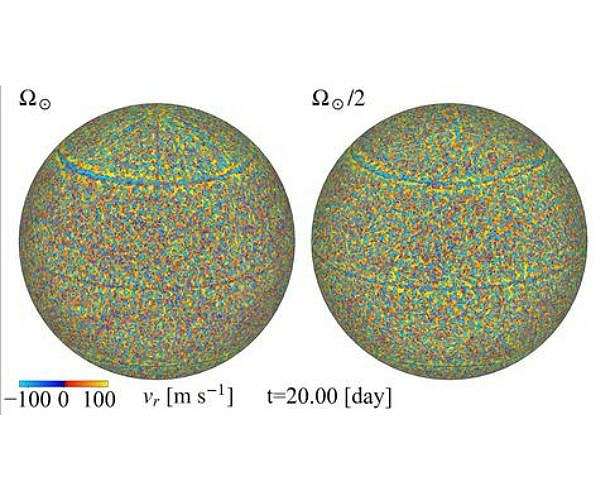
Researchers using one of the worlds most powerful supercomputers have overturned a long standing theory about how stars like the Sun rotate as they age. For more than four decades, models suggested that middle aged and older solar type stars should eventually flip their rotation pattern so that their poles spin faster than their equators, a configuration known as anti solar differential rotation.
A team at Nagoya University in Japan has now shown that this flip may never occur in real stars. Their high resolution simulations instead indicate that solar type stars keep the same rotation pattern throughout their lifetimes, with the equator rotating faster than the poles.
Solar type stars are similar to the Sun in mass and temperature and include many of the yellow, medium sized stars thought most likely to host habitable planets over billions of years. Unlike Earth, which rotates as a solid body, the Sun is made of hot gas and shows differential rotation, with its equator taking about 25 days to spin once while regions near the poles take about 35 days.
Previous theoretical work argued that as stars gradually lose angular momentum and spin down over billions of years, the pattern of gas flows in their interiors should change. In those models, slow rotation allowed large scale convective flows to transport angular momentum in a way that reversed the contrast between equator and poles, leading to anti solar differential rotation in older stars.
The new study finds that this picture missed a key ingredient. By resolving small scale turbulent motions and magnetic fields that earlier, lower resolution simulations could not sustain, the Nagoya team shows that magnetism and turbulence work together to keep the equator spinning faster than the poles.
Inside the modeled stars, turbulent flows of hot gas and magnetic fields interact to redistribute angular momentum. The calculations reveal that these processes naturally maintain a solar type rotation profile over a wide range of rotation rates. Even as stars slow down, the simulations show no transition to an anti solar regime.
"We found that these two processes, turbulence and magnetism, keep the equator spinning faster than the poles throughout the stars life, not just when the star is young," said Hideyuki Hotta, a coauthor and professor at Nagoya Universitys Institute for Space Earth Environmental Research. "So even though stars do slow down, the switch does not happen because magnetic fields, which previous simulations missed, prevent it."
To obtain these results, the researchers used the Japanese supercomputer Fugaku, installed at the RIKEN Center in Kobe. They divided each simulated solar type star into about 5.4 billion grid points, allowing them to follow fine scale variations in velocity and magnetic field that would otherwise disappear in numerical diffusion.
Earlier simulations at much lower resolution tended to artificially damp magnetic fields in stellar interiors. As a result, those models underestimated the role of magnetism in setting rotation patterns and tended to produce anti solar rotation in slowly spinning stars. In the new work, the fields remain strong enough to exert a back reaction on the flows and enforce a solar like state.
The simulations also track how stellar magnetic fields evolve over time. They suggest that the overall magnetic field strength declines steadily as stars age and spin down, with no late life resurgence tied to a rotation flip. That finding contradicts earlier ideas that anti solar rotation in old stars might trigger a new phase of strong magnetism.
For many years, theorists faced a disconnect between their models and observations. While simulations predicted that very slowly rotating solar type stars should show anti solar differential rotation, astronomers did not see such a pattern in real stars. Observational methods have limited sensitivity, especially for distant stellar surfaces, and the apparent absence of anti solar rotation remained an open question.
According to coauthor Yoshiki Hatta, the new calculations resolve that tension. "The simulation can reproduce the Suns observed rotation pattern almost perfectly. When we apply it to slower rotating stars, it also matches astronomical observations and shows no anti solar rotation," he said.
A more accurate description of how angular momentum, turbulence, and magnetic fields interact inside stars has broad implications. The rotation profile of a star helps shape its magnetic dynamo, which is responsible for cycles of activity such as the Suns roughly 11 year sunspot cycle.
By providing a more realistic picture of the internal flow and field structure over stellar lifetimes, the Nagoya simulations may help explain why the Sun and similar stars show their specific levels and patterns of magnetic activity. That in turn affects the high energy radiation and particle environments surrounding orbiting planets.
Magnetic fields and stellar winds can strip atmospheres, drive space weather, and influence whether planets remain habitable over billions of years. Improved models of stellar interiors could therefore sharpen long term forecasts of planetary habitability in systems around Sun like stars.
The new results may also feed into refined stellar evolution models that aim to track how stars lose spin, cool, and change luminosity from youth to old age. With better constraints on rotation and magnetism, astronomers can interpret changes in stellar brightness and activity more reliably when they study distant stars across the galaxy.
Research Report:The prevalence of solar like differential rotation in slowly rotating solar type stars
