
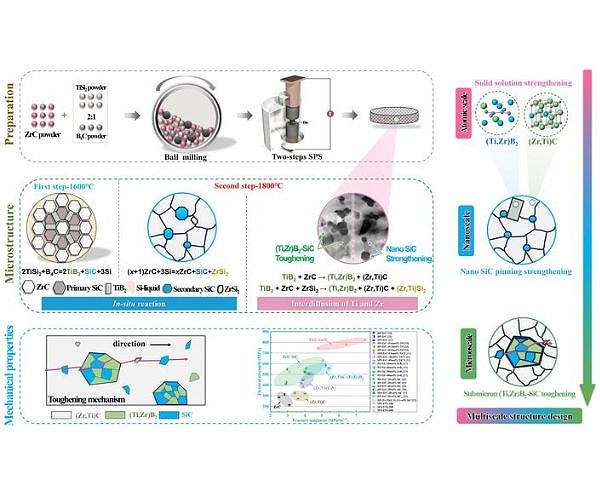
With the growing demands on materials used in extreme environments such as hypersonic flight, advanced propulsion systems, and next generation nuclear energy, ultra high temperature ceramics are attracting increasing interest. Among these materials, zirconium carbide is a leading candidate because it combines an exceptionally high melting point with excellent solid state stability at very high temperatures in aggressive environments.
Despite these advantages, practical use of zirconium carbide has been limited by two longstanding challenges. The material is difficult to densify and typically requires very high processing temperatures, and it is intrinsically brittle, which restricts its structural reliability in demanding service conditions. Many previous efforts have tried to improve performance through solid solution formation, second phase reinforcement, or composite design, but these approaches have usually improved either strength or toughness at the expense of the other.
A team of materials scientists led by Boxin Wei of Harbin University of Science and Technology and Yujin Wang of Harbin Institute of Technology in China has now demonstrated a way to overcome this trade off by engineering a multi scale microstructure in a zirconium carbide based ceramic. Using a two step in situ reactive spark plasma sintering process starting from zirconium carbide, titanium disilicide, and boron carbide powders, the researchers produced a multiphase ceramic that combines high flexural strength with significantly improved fracture toughness.
The work, reported in the Journal of Advanced Ceramics on 12 February 2026, focuses on what the authors describe as the core challenge of simultaneously enhancing densification behavior and fracture resistance in zirconium carbide ceramics. "The core challenge we aimed to address was how to simultaneously enhance both densification behavior and fracture resistance in ZrC ceramics," explained Boxin Wei, associate professor at the School of Materials Science and Chemical Engineering, Harbin University of Science and Technology. "Our approach was to leverage a carefully designed sequence of in-situ reactions that would not only promote low-temperature densification but also create a hierarchical microstructure with reinforcing phases operating at different length scales."
The design strategy centers on the reaction between titanium disilicide and boron carbide, which proceeds in two stages during spark plasma sintering. In the first step at 1600 C, titanium disilicide reacts preferentially with boron carbide to form titanium diboride and primary silicon carbide, while the silicon released from this reaction subsequently reacts with the zirconium carbide matrix to form zirconium disilicide and secondary silicon carbide. The sintering schedule of three minutes at 1600 C followed by ten minutes at 1800 C was chosen to separate reaction dominated and diffusion dominated stages so that all in situ reactions could complete before most grain growth takes place.
This two step schedule allows transient liquid phase sintering, extensive interdiffusion of zirconium and titanium, and the formation of (Zr,Ti)C and (Ti,Zr)B2 solid solutions throughout the microstructure. "The two-step process is essential to our success," noted Yujin Wang, professor at the Institute for Advanced Ceramics, Harbin Institute of Technology. "The lower-temperature hold prioritizes completion of the in-situ reactions, generating a high density of fine TiB2 and SiC nuclei while intentionally limiting matrix grain growth. With these pinning phases already dispersed throughout the microstructure, the subsequent high-temperature sintering achieves full density while the nanoscale particles effectively suppress grain coarsening from the outset."
When 30 mol percent titanium disilicide and 15 mol percent boron carbide were added, the resulting ZTS 30B ceramic developed a refined sub microstructure with grain sizes below 500 nanometers. In mechanical tests it reached a flexural strength of 824 plus or minus 46 megapascals and a fracture toughness of 7.5 plus or minus 0.5 megapascals times the square root of meters, substantially higher than values reported for most zirconium carbide based ceramics prepared by conventional routes.
According to the researchers, this performance arises from a genuinely multi scale synergy. At the atomic scale, solid solution strengthening in (Zr,Ti)C and (Ti,Zr)B2 generates lattice strain fields that impede dislocation motion and raise strength. At the nanoscale, primary silicon carbide formed alongside titanium diboride and secondary silicon carbide formed from the reaction of silicon with the zirconium carbide matrix both act as effective grain boundary pinning particles that restrict grain coarsening and stabilize the fine grained microstructure.
At the microscale, plate like titanium diboride grains and SiC TiB2 agglomerates promote toughening by deflecting and bridging cracks, forcing fracture paths to become more tortuous and dissipating more energy. The presence of a higher toughness zirconium disilicide phase provides further energy absorption during crack propagation. "The in-situ formation of SiC-TiB2 agglomerates is particularly noteworthy- these structures act as effective composite toughening units, with the interlocked SiC and TiB2 phases deflecting propagating cracks and extending crack paths in ways that individual reinforcing phases cannot achieve alone," said Wei.
High resolution transmission electron microscopy gave additional insight into how the microstructure contributes to mechanical behavior. Secondary silicon carbide particles were found to maintain a specific crystallographic orientation relationship with the surrounding (Zr,Ti)C matrix, which reduces lattice mismatch and improves stress transfer across the interface. A high density of stacking faults within beta silicon carbide grains further hinders dislocation motion, enhancing resistance to deformation. At interfaces between (Zr,Ti)C and (Ti,Zr)B2, an interdiffusion zone roughly 9 nanometers thick was observed, indicating good chemical compatibility and strong interfacial bonding.
The team also compared their two step reactive sintering route with a more conventional one step process. In the one step schedule, the densification rate exhibited a strong peak at 1800 C, indicating that intense in situ reactions were still taking place at that temperature. This behavior promoted rapid Ostwald ripening and grain coarsening, which undermines mechanical properties. In contrast, the two step approach showed a much lower densification rate peak at 1800 C, consistent with the major reactions having largely completed during the earlier 1600 C hold. Shrinkage data indicated that over 20 percent of total densification in the two step samples occurred at 1600 C, compared with significantly less in the one step samples.
By carefully controlling the reaction sequence and thermal history, the researchers were able to fundamentally reshape the relationship between microstructure and properties in this class of carbide ceramics. The combined effects of solid solution strengthening, nanoscale grain boundary pinning, and microscale toughening units produced a zirconium carbide based ceramic that is both strong and relatively damage tolerant, addressing a key barrier to the wider use of these materials in structural roles at extreme temperatures.
The study also emphasizes that titanium disilicide plays several roles simultaneously in this system. It acts as a reactive sintering aid that forms a transient liquid phase to promote densification, it supplies silicon for the in situ formation of silicon carbide, and it provides titanium that later partitions into both the carbide and boride solid solution phases. This multifunctional behavior of a single additive is central to the effectiveness of the overall design strategy.
Beyond the immediate results, the authors suggest that the in situ multiscale construction strategy demonstrated here could be adapted to other ultra high temperature ceramic families where similar trade offs between densification, strength, and toughness exist. Systems based on other refractory carbides and borides may benefit from analogous combinations of solid solution formation, reactive sintering aids, and engineered multi phase microstructures that operate across atomic, nano, and micro length scales.
