
Military Space News
SPACE MEDICINE
Lost in space: Sperm struggles to navigate during weightless sex

Lost in space: Sperm struggles to navigate during weightless sex

By Daniel Lawler
Paris, France (AFP) Mar 30, 2026
Scientists have used a tiny plastic "obstacle course" to test how much sperm would struggle to navigate during sex in the weightlessness of space.

Some particularly resilient sperm still made it through the course, suggesting that conceiving children in space will still be possible, according to research published on Thursday.

However a bigger problem could be that the development of embryos after fertilisation was harmed by a lack of gravity, the Australian team of researchers found.

With humanity setting its eyes on colonising space -- next week NASA hopes to launch its first crewed mission around the Moon in half a century -- scientists have been studying how difficult it will be to procreate on spaceships or other worlds.

One of the biggest challenges is that sperm will no longer be pulled downwards by Earth's gravity.

"Sperm need to actively find their way to an egg, and this study is the first to put that ability to the test under space-like conditions," Nicole McPherson, a researcher at Adelaide University in Australia, told AFP.

The scientists used a plastic chamber that resembles the female reproductive tract to act as a "miniature obstacle course", the senior author of the new study said.

"Think of it as a tiny race track... sperm are introduced at one end and have to swim their way through to the other."

- Filtering out weak runners -

Both human and mice sperm were sent down the course, which was inside a device that uses constant rotation to simulate the microgravity of space.

The sperm was about 50 percent worse at navigating through the course compared to how they perform under Earth's gravity.

This worked out to be roughly a 30-percent drop in successful fertilisation, according to the study in the journal Communications Biology.

However the sperm that did make it through seemed to produce better-quality embryos, which could turn out to be "beneficial", McPherson said.

It appeared that the stress of microgravity acted as a "filter" that effectively cleared the field, "leaving only the most capable sperm in the running," she explained.

A bigger problem came in the first 24 hours after sperm had fertilised the eggs.

"The results reversed sharply, with fewer embryos formed, and those that did were of poorer quality," McPherson said.

This suggests that microgravity "may not be the deal-breaker we feared, but protecting the embryo from weightlessness in those critical first hours will likely be essential for reproduction in space," she added.

Some including billionaire SpaceX founder Elon Musk have ambitious plans to make humans an interplanetary species by establishing settlements on the Moon then Mars.

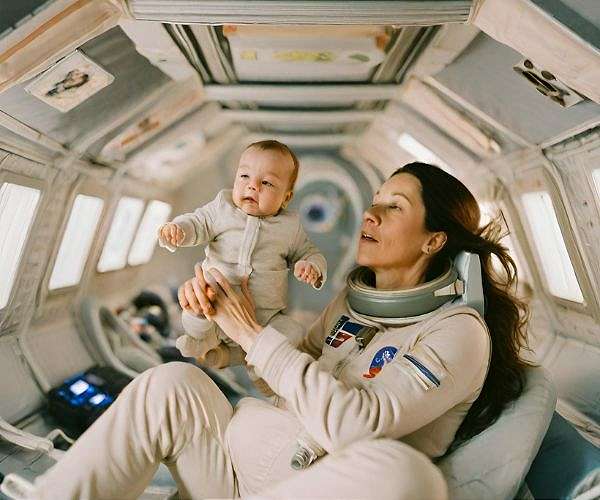
There has also been speculation that the first baby conceived outside the bounds of Earth could be the result of a couple having sex on a flight launched by the booming space tourism industry.

McPherson emphasised that much more research is needed to understand how reproduction works in space, adding that fertilisation is "only one small piece of a very long and complex puzzle".

"We are still a long way from seeing the first space baby."

Related Links
Space Medicine Technology and Systems

Subscribe Free To Our Daily Newsletters
RELATED CONTENT
The following news reports may link to other Space Media Network websites.
SPACE MEDICINE
Biofilm communities seen as key to safer long term spaceflight
Los Angeles CA (SPX) Mar 11, 2026
A global team of scientists has identified biofilms, the structured microbial communities that form on surfaces, as a critical yet underappreciated factor for the future of human space exploration. The researchers argue that understanding how these microbial communities behave in space will be essential for protecting astronaut health and enabling long duration missions. University of Houston microbiologist Madhan Tirumalai, a member of NASAs Analysis Working Groups, contributed to a new review in ... read more

SPACE MEDICINE
NATO intercepts second Iran missile in Turkish airspace

Japan to deploy counter-strike missiles closer to China

Italy to send air-defence aid to Gulf countries; France allowing US aircraft on some Mideast bases

Leonardo DRS infrared payloads selected for SDA Tracking Layer Tranche 3

SPACE MEDICINE
Turkey says missile launched from Iran destroyed by NATO

Hypersonica completes milestone hypersonic missile flight test in Norway

Raytheon advances next generation short range interceptor with ballistic test

Russian strikes kill 4, wound two dozen in Ukraine

SPACE MEDICINE
Hawk shape shifting in flight may guide future drone control

EU's Kallas warns anti-drone stock 'limited' as Mideast, Ukraine wars rage

Airspan extends 5G in motion to defense aerial networks

Zelensky says 11 countries asking Ukraine for drone help against Iran

SPACE MEDICINE
MTN to deliver secure SpaceX government satcom for defense customers

EU brings secure GOVSATCOM hub online under GMV leadership

Balerion backs Northwood to tackle ground bottlenecks in expanding space economy

Aalyria spacetime platform tapped for AFRL space data network trials

SPACE MEDICINE
New electrolyte design aims to make giant flow batteries safer

Aitech and Teledyne expand partnership on space grade SP1 computing platform

Gilat wins 9 million dollar MOD deal for secure defense satcom

Norway buys French bombs for Ukraine: ministry

SPACE MEDICINE
Anthropic takes Trump administration to court over Pentagon row

Global arms exports soar on European demand: study

China boosts military spending with eyes on US, Taiwan

BAE Systems posts record order backlog as defence spending rises

SPACE MEDICINE
Vibes war? Trump pitches Iran conflict on 'feeling'

China says opposes any targeting of new Iran leader

Four years after banning Russia, FIFA and IOC passive in the face of war

Mojtaba Khamenei: son and successor to Iran's supreme leader

SPACE MEDICINE
Ultrafast thermal detector pushes gigahertz performance frontier

Carbon fibers bend and straighten under electric control

Engineered substrates sharpen single nanoparticle plasmon spectra

Subscribe Free To Our Daily Newsletters


The content herein, unless otherwise known to be public domain, are Copyright 1995-2026 - Space Media Network. All websites are published in Australia and are solely subject to Australian law and governed by Fair Use principals for news reporting and research purposes. AFP, UPI and IANS news wire stories are copyright Agence France-Presse, United Press International and Indo-Asia News Service. ESA news reports are copyright European Space Agency. All NASA sourced material is public domain. Additional copyrights may apply in whole or part to other bona fide parties. All articles labeled "by Staff Writers" include reports supplied to Space Media Network by industry news wires, PR agencies, corporate press officers and the like. Such articles are individually curated and edited by Space Media Network staff on the basis of the report's information value to our industry and professional readership. Advertising does not imply endorsement, agreement or approval of any opinions, statements or information provided by Space Media Network on any Web page published or hosted by Space Media Network. General Data Protection Regulation (GDPR) Statement Our advertisers use various cookies and the like to deliver the best ad banner available at one time. All network advertising suppliers have GDPR policies (Legitimate Interest) that conform with EU regulations for data collection. By using our websites you consent to cookie based advertising. If you do not agree with this then you must stop using the websites from May 25, 2018. Privacy Statement. Additional information can be found here at About Us.